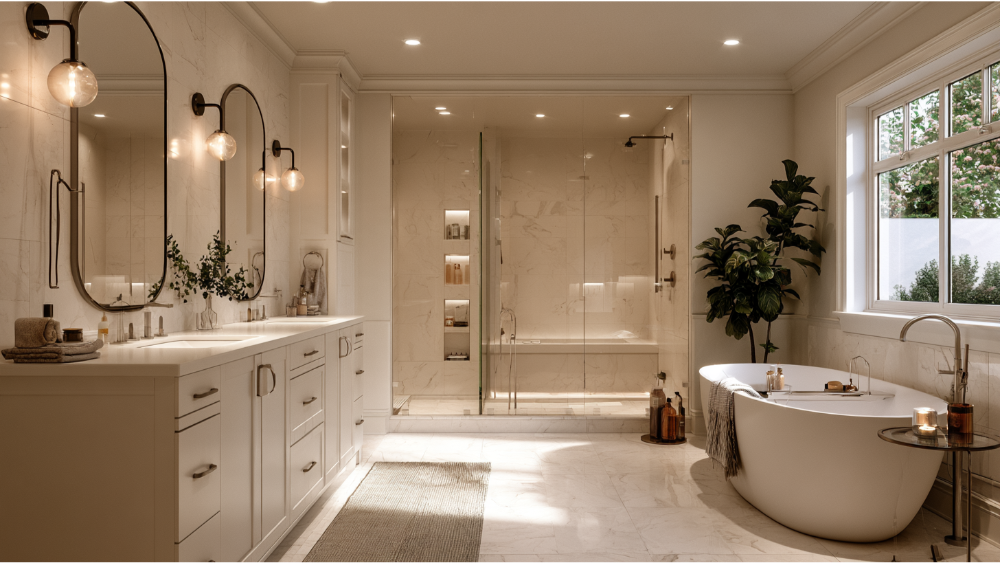
Key Takeaway
The average cost of remodeling a master bathroom is about $25,000 nationally for a major project, rising to $30,000 for bathrooms 100 square feet or larger, according to the 2026 U.S. Houzz Bathroom Trends Study. Labor alone accounts for 40% to 65% of the total budget. Keeping the existing plumbing layout is the single biggest way to control costs, while moving drains or walls can push the project well above these medians.
Nationally, a major master bathroom remodel runs a median of about $25,000, defined as a project that upgrades at least the shower. For bathrooms measuring 100 square feet or more, that median climbs to roughly $30,000, and the top 10% of major projects land at $70,000 or above. Those figures come from the 2026 U.S. Houzz Bathroom Trends Study, which surveyed 1,619 homeowners about work completed in 2025.
If you’re trying to decide whether a remodel is realistic before you call anyone, this guide walks through what actually drives that number, what a complete estimate should include, and how to set a budget you can hold. We use “master bathroom” and “primary bathroom” to mean the same room. One note before we go further: every dollar figure here is national third-party survey data, not America’s Dream HomeWorks pricing and not a quote for your home.
Average Cost of Remodeling a Master Bathroom: The National Numbers
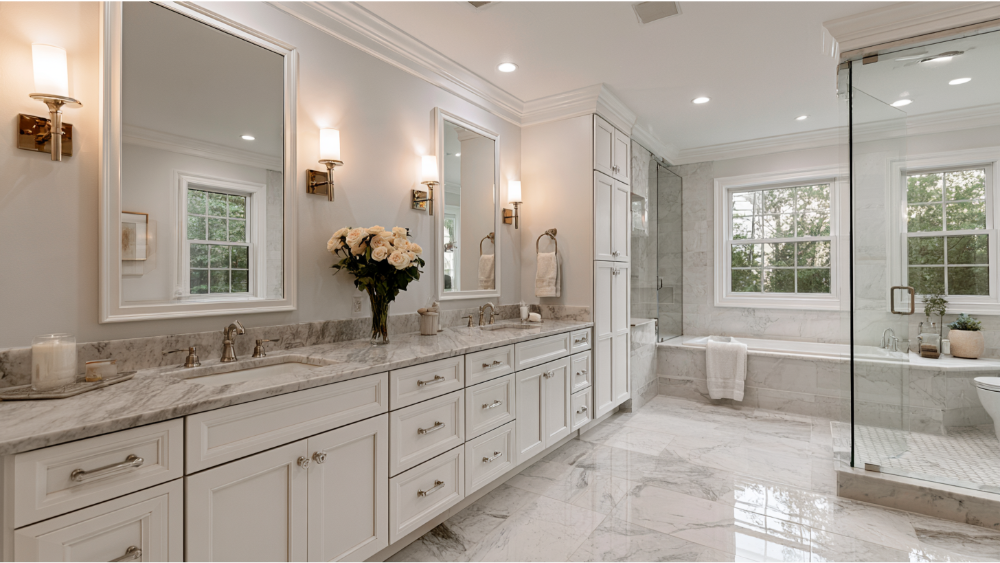
Here’s how the current national benchmarks break down by project type.
| Project type | National benchmark | What’s typically included |
|---|---|---|
| All surveyed bathroom projects | $15,000 median | Everything from small refreshes to gut remodels |
| Major remodel | $25,000 median | At least the shower upgraded, often more |
| Bathroom 100+ sq. ft. | $30,000 median | Larger primary baths, more tile and fixtures |
| Top 10% of major projects | $70,000+ | Premium finishes, layout changes, custom work |
| Top 10%, 100+ sq. ft. | $75,000+ | Large footprint plus high-end selections |
Pay attention to the word median. A median means half of the surveyed projects cost more and half cost less. That’s different from a mathematical average, which gets pulled upward by a handful of very large projects and can misrepresent what a typical homeowner actually spent. For planning purposes, the median is the more honest starting point.
These are national figures. They are not a Concord quote, and Northern California estimates frequently sit above them for reasons we’ll cover below.
What Counts as a Master Bathroom Remodel? Three Levels of Scope
Scope is defined by the work included, not by a price tier. Most projects fall into one of three levels:
- Cosmetic refresh. New fixtures, vanity top, paint, lighting, maybe flooring. Same footprint, same plumbing, nothing opened up.
- Full replacement in the same footprint. Demolition to the studs, new shower pan and waterproofing, new tile, vanity, flooring, and fixtures, with drains and supply lines staying put. This is where most primary bath remodels live. In the Houzz study, 82% of renovated bathrooms kept the same overall footprint.
- Layout-changing or expanded remodel. Moving plumbing, taking down a wall, borrowing closet space, or adding square footage. About 40% of projects involved a reworked layout and 38% involved wall modifications.
A primary bath carries more cost than a hall bath or powder room for straightforward reasons: more fixtures, more tile, more square footage, and higher expectations for storage, lighting, and comfort.
Why Bathroom Remodel Costs You Find Online Vary So Much

You can find one source saying $11,500 and another saying $27,000 for what sounds like the same room. The gap usually comes down to what’s being measured:
- Homeowner survey medians report what real people actually paid, across wildly different scopes.
- Calculator or modeled estimates build a number from assumed inputs, often with false precision down to the dollar.
- DIY material totals exclude labor entirely.
- Labor-only bids exclude materials.
- Permit valuations are a filing figure, not a budget.
- Full-service design-build proposals include design, permitting, procurement, and warranty.
Every source also defines “major remodel” differently. A number only means something once you know what work it covers, which is why comparing identical scope beats comparing headline figures.
How much of a bathroom remodel is labor?
Labor typically accounts for 40% to 65% of total bathroom remodel expenses nationally, with hourly rates varying widely by region. That’s why a small bathroom can cost more per square foot than a larger one: demolition, waterproofing, plumbing, electrical, and inspections are largely fixed regardless of room size.
Does Keeping the Same Layout Save Money?
Yes. Leaving drains, supply lines, and walls where they are is the single biggest cost lever most homeowners control, and it’s why 82% of renovated bathrooms stay in the same footprint. Relocating plumbing means opening floors and walls, adding framing and structural work, and extending the schedule.
But don’t preserve a layout that genuinely doesn’t work. If the shower is too cramped to turn around in, there’s nowhere to put towels, or the room won’t accommodate you comfortably in fifteen years, that’s worth solving now. Nearly half of homeowners (49%) enlarged their shower, and among the 26% who removed a tub, 79% used the reclaimed space to make the shower bigger. That’s a layout change that pays off every single morning.
What a Complete Bathroom Renovation Estimate Should Include
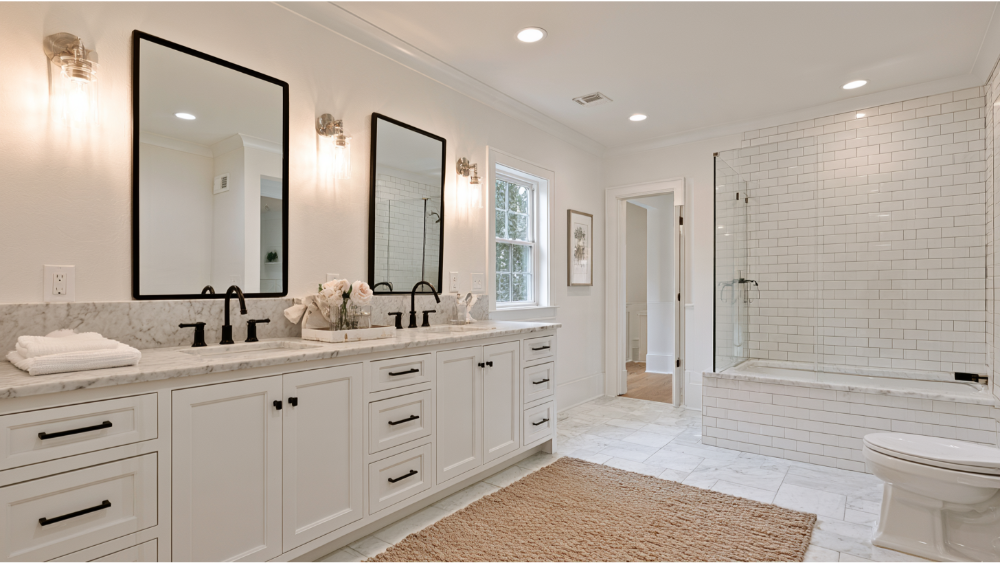
Eighty-nine percent of bathroom renovators hired at least one professional, and 52% hired a general contractor. Hold any proposal you receive against this list:
- Design work and field measurements
- A written scope with drawings
- Who pulls the permits
- Demolition and debris removal
- Floor and home protection during construction
- Plumbing, electrical, and ventilation work
- Framing and wall repair
- The waterproofing system
- Tile and finish installation
- Vanity, cabinetry, countertop, and fabrication
- Shower glass, mirrors, and accessories
- Stated product allowances and written exclusions
- Inspection coordination
- Final cleanup and punch list
- A written change-order procedure
- Labor and manufacturer warranties
Two quotes can differ by thousands for one reason: one of them leaves half this list out and the other doesn’t.
How to Set a Realistic Budget (and Keep It)
Across more than 20,000 respondents in the 2026 Houzz & Home Study, 75% of renovating homeowners set an initial budget and 37% went over it. The causes are fixable: 52% hit products or services that cost more than expected, 35% upgraded materials mid-project, and 31% expanded the scope after work began.
So rank your must-haves against your nice-to-haves before you talk numbers. Finalize your major selections (tile, vanity, countertop, fixtures) before demolition starts, because that’s where the surprise upgrades happen. Hold back 10% to 20% as a contingency for hidden conditions. Put your money into waterproofing, ventilation, and tile prep before you spend it on visible extras, because the wet areas are what fail first. Bathroom remodels typically recoup roughly 60% to 70% at resale, though for a room you use twice a day, the daily payoff matters more. If timing is the obstacle, we offer flexible financing options worth discussing during your consultation.
What Concord and Bay Area Homeowners Should Plan For
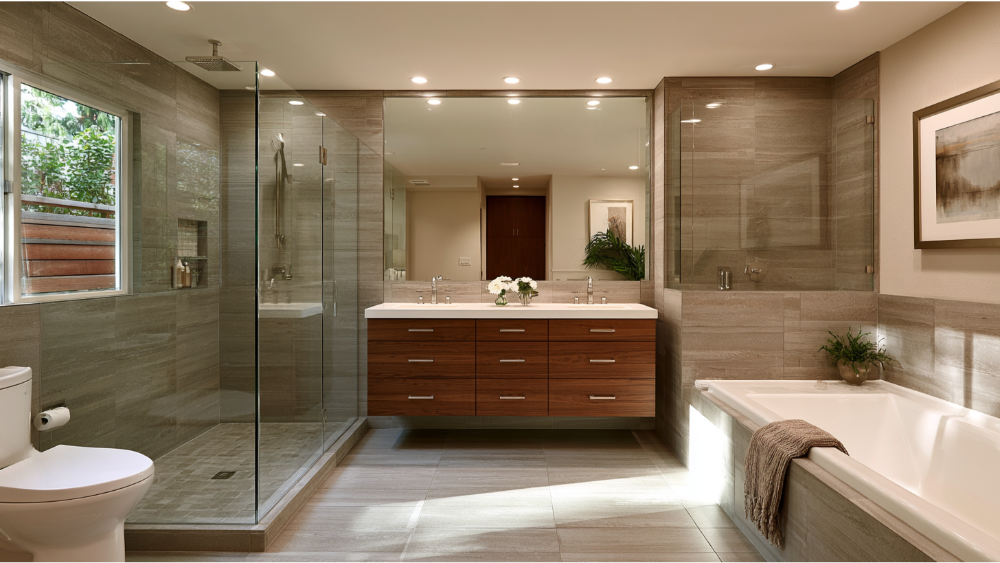
Labor rates, permitting, and the age of local housing stock mean Northern California and Bay Area estimates often sit above national medians. Treat the figures above as a starting frame, not a Concord quote.
- Permits are required. The City of Concord lists both new and replacement bathroom remodels, plus new and replacement shower and tub enclosures, as work requiring a permit. Verify your exact scope and fees through the City’s Permit Portal and Project Pal tool.
- Verify the license. California requires a CSLB license for work that needs a permit, uses additional workers, or carries a contract value of $1,000 or more.
- Know the down-payment limit. On a California home improvement contract, the down payment cannot exceed $1,000 or 10% of the contract price, whichever is less.
- Plan for ventilation and energy code. California requires mechanical ventilation in bathrooms containing a tub or shower, and the 2025 California Energy Code applies to permit applications submitted on or after January 1, 2026.
- Older homes need lead-safe planning. Federal RRP rules cover renovation that disturbs painted surfaces in most pre-1978 housing. Plenty of East Bay homes predate that cutoff. We’re an EPA Lead-Safe Certified Firm, so that work is handled correctly when it applies.
Key Factors That Determine Your Bathroom Remodel Costs
These are the variables that move your number most, roughly in order of impact:
- Size and fixture count. More square footage means more tile, more waterproofing, and more labor hours. A double vanity, separate tub, and large shower cost more than a single vanity and a tub-shower combo.
- Keeping or changing the footprint. The biggest single swing in most projects.
- Moving plumbing, walls, electrical, or ventilation. Relocating a drain means opening the floor. Moving a wall means framing, drywall, and often electrical rework.
- Shower and tub configuration. Curbless entry, a bench, body sprays, and frameless glass all add labor and material.
- Vanity, storage, countertop, and cabinetry. Custom cabinetry built to your room costs more than a stock vanity and lasts considerably longer. We build our DreamLine Custom Cabinetry and fabricate stone countertops in-house, which keeps the sizing and finish decisions in one set of hands.
- Tile coverage, pattern, and waterproofing. Floor-to-ceiling tile, mosaics, and herringbone patterns take more time to set. Substrate prep and a proper waterproofing system are not places to economize.
- Fixtures and finish level. Material selections account for roughly half of a typical remodel budget, and the spread between builder-grade and high-end is enormous.
- Hidden conditions. Water-damaged subfloor, corroded supply lines, undersized electrical, or previous unpermitted work all surface after demolition starts.
- Permits and inspections. Nationally these run somewhere between a few hundred and roughly $1,800 depending on jurisdiction and scope.
- Who delivers the project and what their warranty covers. A proposal that includes design, permitting, and a labor warranty is a different product than a bid for installation only.
Why Design-Build Accountability Protects Your Investment

A complete scope only helps you if one team is actually responsible for all of it. We’ve been family-owned since 2001, and we’ve transformed homes for 19,000+ homeowners by keeping design, permitting, material procurement, DreamLine Custom Cabinetry, stone fabrication, and installation under one roof. You’ll never go searching for another contractor to finish what we started.
We’re licensed in California under CSLB #853669, EPA Lead-Safe Certified, and A+ BBB Accredited. Every remodel carries our 24-month labor warranty, and DreamLine Custom Cabinetry carries a limited lifetime warranty. What that buys you isn’t a lower price. It’s a clearer scope, one accountable team, and a bathroom that works on the busiest weekday morning of your year.
Frequently Asked Questions
What is the 30% rule in remodeling?
It’s a common guideline suggesting you avoid spending more than about 30% of your home’s value on a single renovation. Treat it as a sanity check rather than a rule, and pair it with the related habit of holding 10% to 20% of your budget in reserve for hidden conditions.
Is it worth remodeling a master bathroom?
For most homeowners, yes. Bathroom remodels generally recoup roughly 60% to 70% of their cost at resale, and a primary bath you use twice a day returns something harder to measure: better storage, safer bathing, and easier mornings.
Is $10,000 enough to remodel a bathroom?
It can cover a cosmetic refresh or a smaller bathroom in its existing footprint. A full primary bath remodel sits well above that nationally, with a $25,000 median for major projects, and the gap widens if plumbing moves.
What is the most expensive part of redoing a bathroom?
Labor, at 40% to 65% of the budget nationally. Within the room itself, the shower and wet area is the costliest component once you account for waterproofing, tile work, glass, and plumbing.
Get a Number That’s Actually Yours
National medians tell you whether a remodel is realistic. An itemized, scope-complete estimate tells you what your bathroom will take. Call (916) 701-9660 or submit our online form to Schedule a Free Consultation, or Visit Our Showroom: our 20,000-square-foot Grand Kitchen and Bath Showroom in North Highlands, where you can handle materials and use our Bathroom Visualizer Tool before you commit to anything.