Key Takeaway
For kitchens, luxury vinyl plank vs laminate comes down to one key difference: LVP’s polymeric core won’t swell when water reaches a seam, while laminate’s wood-fiber core can warp if moisture lingers. A NALFA LF-01 certified, water-resistant laminate is still a solid option when scratch resistance and realistic wood texture are your priorities, as long as the warranty explicitly permits kitchen use. Match the product to the room’s actual conditions, not the marketing label.
For most kitchens, a kitchen-rated luxury vinyl plank is the safer default. Its rigid polymeric core won’t swell the way laminate’s wood-fiber core can when water finds a seam. That said, a certified water-resistant laminate is still a credible choice when scratch resistance and convincing wood texture matter most to you, as long as the warranty expressly permits kitchen installation.
If you’re standing in front of two samples trying not to make an expensive mistake, this is for you. We’ll walk through the real differences, the spec details that actually predict performance, and why the floor has to be planned alongside your cabinets and appliances. We’ve helped homeowners work through this exact decision since 2001, across more than 19,000 projects.
What’s Actually Different About Luxury Vinyl Flooring and Laminate Flooring?
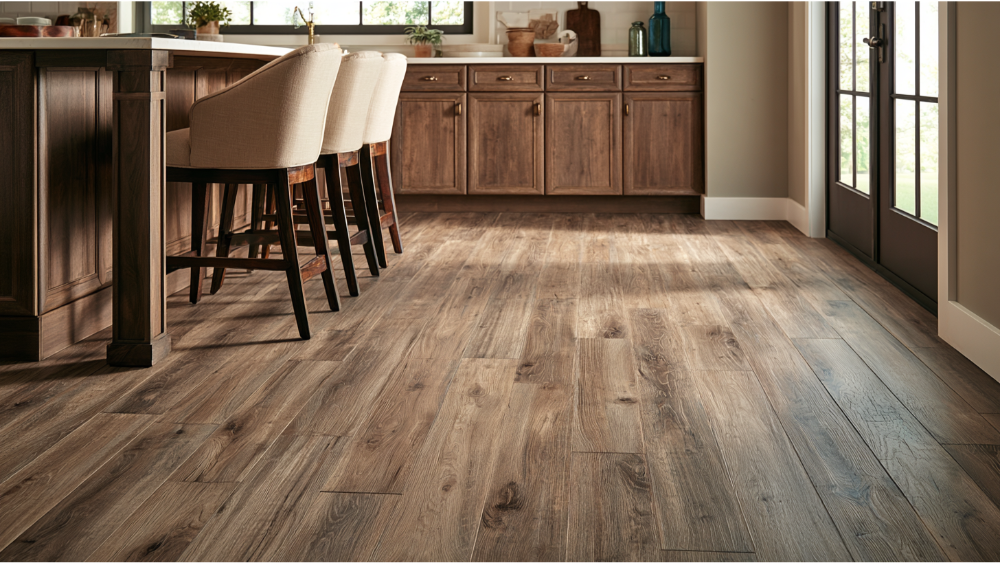
Laminate flooring is a wood product. NALFA defines its core as high-density fiberboard denser than 800 kg/m³ (50 lb/ft³), with a printed decorative layer and a hard melamine wear layer on top. That melamine surface is tough. The core underneath consists of wood fiber, and wood fiber swells when it stays wet.
Rigid-core luxury vinyl plank, along with its square-format sibling luxury vinyl tile, is resilient flooring built on a polymeric core, covered by ASTM F3261-26, often with an attached underlayment for sound and minor subfloor irregularities. No wood fiber in the core means no swelling when moisture reaches it.
SPC vs. WPC in Plain English
RFCI describes SPC (stone-plastic composite) as the denser and more durable option, more resistant to indentation and more stable with temperature swings. WPC feels a little softer and gives you more warmth underfoot. The core is what decides how the floor behaves when water gets to it.
Luxury Vinyl Plank vs Laminate for Kitchens at a Glance
Here’s how the two categories generally stack up in a working kitchen. The specific product matters more than the category label.
| Kitchen factor | Luxury vinyl plank | Laminate |
|---|---|---|
| Routine spills | Very forgiving | Wipe promptly |
| Slow appliance leak | Core unaffected | Core at risk of swelling |
| Scratch and abrasion | Good to excellent | Typically harder surface |
| Dents and heavy loads | Softer cores can indent | Firm, resists indentation |
| Comfort underfoot | Softer, warmer | Firm, more like wood |
| Cleaning | Easy, tolerates damp mopping | Damp, not wet |
| Replacing one plank | Possible with click systems | Possible with click systems |
| Certifications to look for | ASTM F3261, FloorScore, ASSURE | NALFA LF-01, TSCA Title VI |
The two categories land in broadly similar price tiers, and installed costs swing more on product quality and method than on which one you pick. On a tight budget, that’s good news: stepping up a tier within either category usually buys you more than switching categories. We’ll put real numbers to your actual kitchen in a free estimate.
Water Resistance: Waterproof Flooring Doesn’t Mean a Waterproof Kitchen
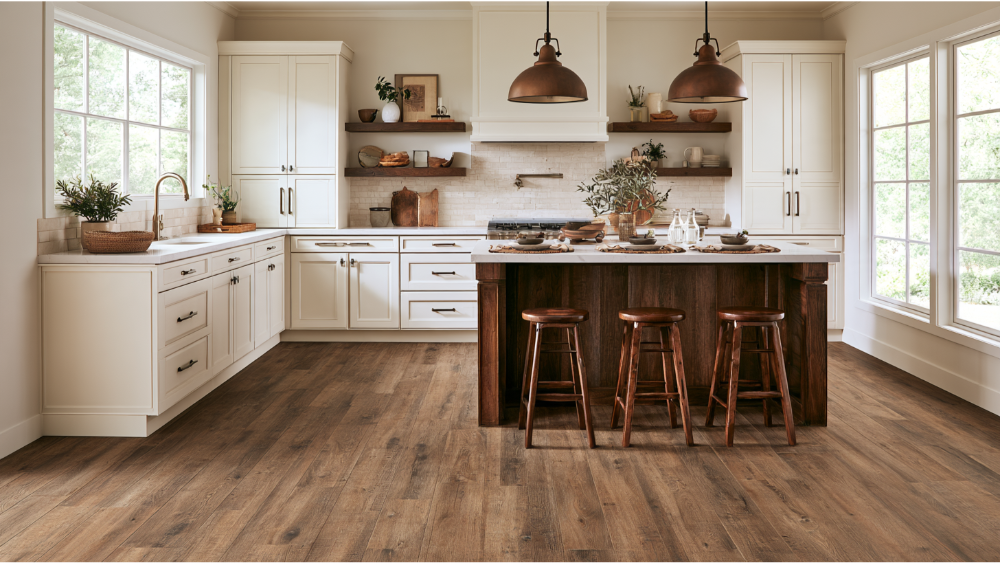
Three separate things get blurred by marketing language: a waterproof plank, a watertight installation, and what your warranty actually covers.
NALFA itself cautions that “waterproof” and “water resistant” are used inconsistently from product to product. The useful test is their optional assembled-joint surface-swell evaluation: standing water left on installed joints for 24 hours, with certification requiring a recovered qualitative rating of 2 or lower and an average recovered swell of 0.3 mm or less. A laminate that passed that behaves very differently from regular laminate wearing an unqualified sticker, whose core is susceptible to warping once water sits on a joint.
Even a genuinely waterproof plank doesn’t make a waterproof room. Water travels through perimeter expansion gaps, seams at transitions, penetrations around pipes, and underneath the floor to the subfloor. Representative resilient-floor warranties exclude damage to subfloors, cabinets, walls, and moldings, and many exclude appliance leaks and floods outright. No flooring material is a substitute for fixing a dripping dishwasher.
Scratches, Dents, and Dropped Cookware: Which Holds Up in a Working Kitchen?
These two materials don’t fail the same way, and that’s the insight most comparisons miss.
Laminate’s melamine surface is genuinely hard and abrasion-resistant, which helps against dog claws, tracked-in grit, and barstools dragged across the island. It can chip on sharp impact, and edges can swell if water sits. LVP flexes, so dropped cast iron is more forgiving, but softer constructions can scuff or hold residual indentation under a heavy refrigerator or narrow island legs. Throw rugs at the sink and stove absorb some of that punishment either way.
Two myths worth correcting. NALFA states that AC ratings measure abrasion resistance only, not scratch, stain, impact, or fade resistance; LF-01 certification evaluates 14 performance categories across 4 end-use levels. And a vinyl wear layer is a thickness measurement (ASTM F410), not a durability score. ASTM tests abrasion, indentation, impact, heat, and chemical resistance separately, because a kitchen floor takes all of that stuff at once.
Comfort, Sound, and How Much It Really Looks Like Wood
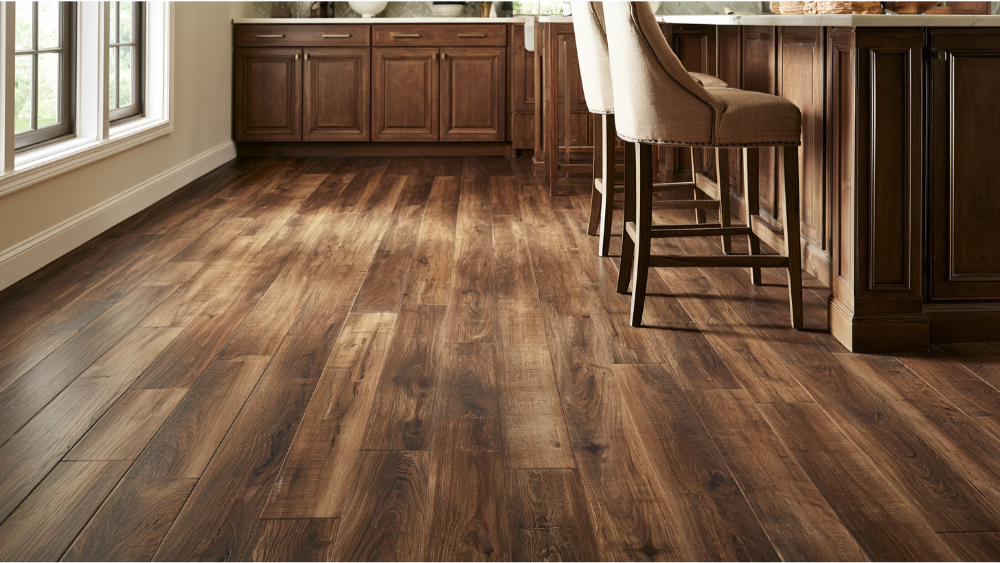
Stand at the sink for an hour and you’ll feel the difference. Laminate reads firm underfoot, closer to real hardwood. WPC and pad-backed LVP give slightly, and they feel warmer in the morning. Laminate without proper underlayment can sound hollow with every step.
For realism, look for embossed-in-register texture that follows the printed grain, beveled edges, matte finishes, and enough plank variation that you don’t see the same maple knot four times across an open floor. Lay samples flat under your kitchen’s actual lighting, next to your cabinet door and countertop samples. If genuine hardwood flooring is what you really want, say so early and we’ll show you that too. That’s exactly what our showroom is for.
Beyond the Kitchen: Bathrooms, Living Rooms, and the Rest of the House
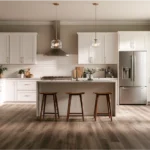
Kitchens usually flow into a dining room or family room, and a single continuous floor means fewer transitions and a cleaner sightline. So the material has to satisfy the wettest room in the run.
LVP is the lower-risk pick for bathrooms, a powder room, laundry rooms, and below-grade basements, and it sits comfortably over a concrete slab with the manufacturer’s required moisture testing. Laminate is very much at home in bedrooms, hallways, and living rooms. Tile and natural stone remain the naturally non-porous option if you want the hardest, fully waterproof surface, with the tradeoff of weight, cold underfoot, and a different installation. If you’re replacing carpet in an old house, expect subfloors that need flattening first, and in pre-1978 homes demolition belongs with an EPA Lead-Safe Certified firm, which we are.
Cabinets, Islands, and Appliances: Plan the Floor Before Anyone Installs It
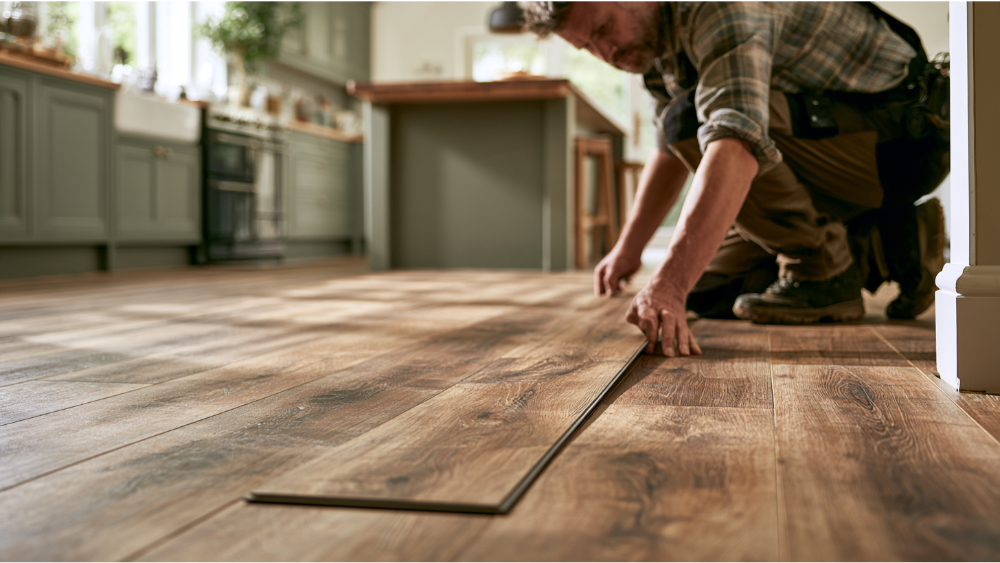
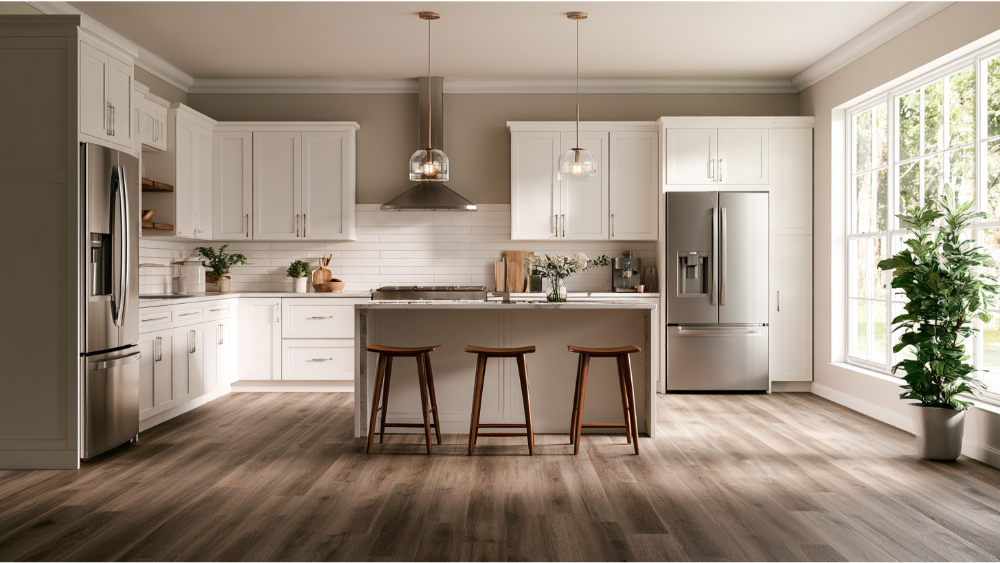
Floating floors have to move. NALFA defines the expansion gap as the space between the flooring and fixed objects that allows that movement, and its installation matrix warns against setting heavy fixed items on top of floating laminate. Representative rigid-LVP instructions say the same thing: set permanent cabinets and islands first, then float the floor around them.
Then there’s finished-floor height. Pulling the dishwasher out years from now should be straightforward, and that clearance has to exist on paper before anyone cuts a plank. Decide early whether flooring runs into appliance bays, how transitions meet adjacent rooms, and what subfloor flatness and moisture testing the product requires. RFCI is clear that manufacturer requirements govern, and the instructions in the box always win.
Because our design, cabinetry, stone fabrication, flooring, and installation all happen under one roof, those decisions get coordinated on one plan with one accountable team. No second contractor.
How to Compare Actual Products (Not Just Categories)
For laminate, ask:
- Does the warranty expressly permit kitchen installation?
- Is it NALFA LF-01 certified?
- Has it passed an assembled-joint water test?
- What are the wet-area sealing requirements at the perimeter?
- Is it TSCA Title VI compliant? Labeling has been required since March 22, 2019.
For LVP, ask:
- Does it comply with ASTM F3261, and is it SPC, WPC, or flexible vinyl?
- Floating or glue-down?
- What are the static-load and locking-system terms?
- Is it FloorScore certified (35 individual VOCs evaluated, including formaldehyde) or ASSURE Certified?
- Does “waterproof” cover the joints or only the plank face, and are appliance leaks and subfloor damage excluded?
You’ll see lifespan ranges quoted online, often around 25 years for vinyl and 15 for laminate. Treat those as loose generalizations, not promises. Real service life depends on the product, the installation, and your traffic. We pull the actual documents for you.
Which Kitchen Floor Should You Choose? A Quick Decision Guide

- Busy family with kids and constant spills: LVP.
- Large dogs, grit, dragged stools: qualified water-resistant laminate or a high-spec SPC.
- Open-concept kitchen into living room: whichever satisfies the wettest room in the run.
- Concrete slab: rigid-core LVP with moisture testing.
- You want the most convincing wood texture and firm feel: premium laminate.
- Any history of dishwasher or refrigerator leaks: LVP, full stop.
LVP is the safer default. Laminate is a legitimate choice with the right documentation behind it. The homeowners who are still super happy a decade later are the ones who matched the product to the room.
Frequently Asked Questions
What are the downsides of luxury vinyl planks?
Can you put a refrigerator on top of LVP?
What is the best type of flooring to put in a kitchen?
Is vinyl flooring a good choice for an old house?
Do high-end homes use luxury vinyl plank?
Let’s Pick the Right Floor for Your Kitchen Together
We’re family-owned, we’ve been at this since 2001, and every phase happens in-house: design, cabinetry, countertops, flooring, and installation. CSLB License #853669, A+ BBB Accredited, EPA Lead-Safe Certified, with a 24-month labor warranty on all remodels. Come see samples under real light in our 20,000-square-foot showroom, the largest of its kind in the region, or Schedule a Free Consultation at (916) 701-9660.