Key Takeaway
A bathroom remodel cost in the Bay Area typically ranges from $25,000 to $45,000 for a full same-layout renovation, while gut projects with layout changes run $45,000 to $90,000 and luxury primary bathrooms can exceed $120,000. Bay Area labor rates average $43.66 per hour for construction trades, well above the national mean of $31.42, which is why local costs outpace national calculators. Scope, plumbing location, and materials are the three biggest drivers of your final number.
Bathroom remodel cost in the Bay Area comes down to scope. Keeping your existing footprint and plumbing where it is costs substantially less than opening walls, relocating fixtures, expanding the room, or adding custom tile and frameless glass. Search “bathroom remodel cost Bay Area” and you’ll find published figures stretching from roughly $15,000 to $120,000 and beyond, which is why there’s no single meaningful average worth quoting. A bathroom renovation that stops at the surface and a bathroom renovation that goes to the studs are two very different projects wearing the same name.
If you’ve been reading cost guides and getting more confused instead of less, that’s not your fault. Every source defines “full remodel” differently. This guide is written for Bay Area homeowners, especially in Concord and the surrounding East Bay cities, who want a realistic budget before they call anyone. We’ll cover scope tiers, what actually moves the number, Concord permits, vanity and flooring choices, and what a complete estimate has to include.
Bathroom Remodel Cost Bay Area: The Four Scope Tiers at a Glance
The figures below are third-party market benchmarks compiled from Bay Area cost guides and national remodeling data. They are not our prices, and they disagree with each other because each source counts different work. Use them to orient yourself, not to plan a contract.
| Project Type | What the Work Actually Includes | Published Benchmark Range |
|---|---|---|
| Cosmetic refresh | Surface upgrades only: paint, mirror, new lighting, fixtures, sometimes flooring and a pre-fab vanity. Nothing behind the walls moves. | Roughly $6,600 to $17,600 (national averages; local labor pushes the top end) |
| Full renovation, same layout | Demo to studs, new waterproofing, tile, flooring, vanity, shower and toilet. Plumbing stays where it is. | Roughly $25,000 to $45,000 |
| Gut renovation with layout change | Relocated drains and supply lines, wall changes, new electrical, custom glass, higher-end materials. | Roughly $45,000 to $90,000 |
| Luxury or expanded primary bathroom | Added floor space, premium stone, heated floors, steam showers, custom vanities, higher-end fixtures. | Roughly $75,000 to $120,000 and up |
The only number that means anything for your home is an itemized estimate built around your actual scope.
Why Bay Area Bathroom Remodel Estimates Vary So Widely
Several factors separate real local pricing from what a national calculator spits out, and labor is the first one. Bureau of Labor Statistics data for May 2025 puts the mean hourly wage for construction and extraction occupations in the San Francisco-Oakland-Fremont metro at $43.66, compared with $31.42 nationally. Higher labor rates here are why labor expenses commonly account for 40% to 60% of the total project cost, so that gap compounds fast across a multi-week job.
Worth separating two different numbers, though. Employee wages are not contractor billing rates. What a licensed general contractor charges also carries workers’ compensation, general liability, licensing, supervision, vehicles, tools, project management, and warranty reserves. Skilled trades in this market are often billed somewhere in the $100 to $200 per hour range once all of that is included.
Geography matters too. San Francisco, the Peninsula, and Marin frequently price above the East Bay, with some sources citing a 15% to 25% premium in the most expensive cities. Even within Contra Costa County, the cost of the same bathroom remodel can shift between cities based on permit fees, review timelines, and how far crews and material deliveries have to travel. Concord, Walnut Creek, Pleasant Hill, Martinez, and Clayton all sit close enough together that labor pricing is similar, but the permits and inspection queues are not identical.
Then there’s access. Third-floor condos, street parking restrictions, HOA work-hour rules, and protecting an occupied home all add real hours that never show up in a square foot calculator. Per square foot pricing works reasonably well for flooring. It works poorly for bathrooms.
Start by Defining Your Bathroom Renovation Scope
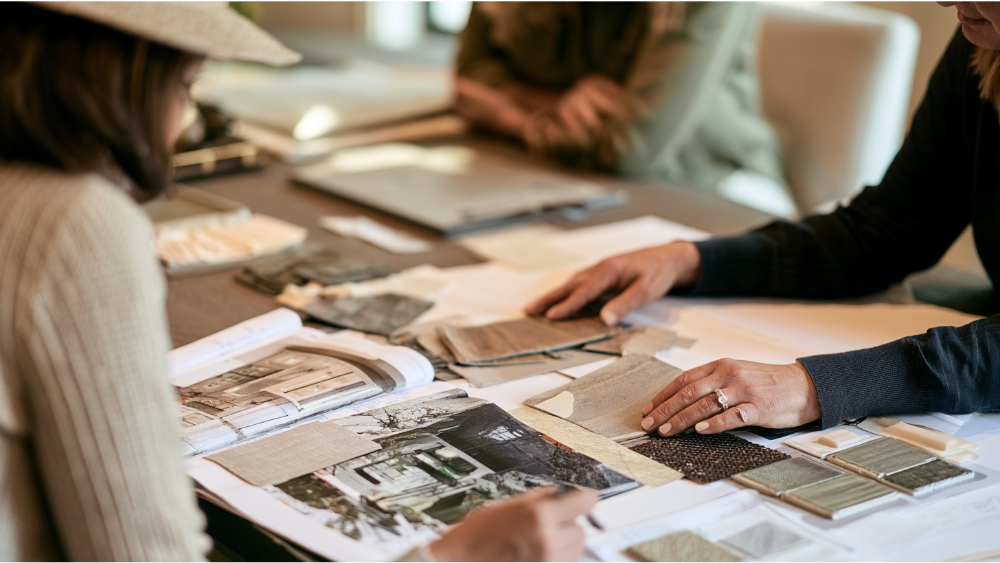
Before any number is useful, you need to know which of these four projects you’re actually planning.
Cosmetic Update
Paint, a new mirror, light fixtures, a toilet swap, a new vanity top, sometimes flooring. Nothing behind the walls moves. This is the fastest path to a bathroom that feels new, and it’s the least expensive tier by a wide margin.
Full Remodel in the Same Layout
Demolition to the studs, then a complete rebuild: new waterproofing, tile, flooring, vanity, shower, toilet, lighting, and ventilation. The plumbing fixtures stay in their existing locations, which is what keeps the cost of this tier well below a gut renovation.
Tub-to-Shower Conversion or Wet-Area Transformation
A targeted scope focused on the wet area alone. When the vanity, flooring, and layout still work for your family, a walk-in shower conversion often delivers the biggest daily improvement for the smallest disruption and the smallest construction footprint.
Gut Renovation With Layout Changes
Moving drains, opening or relocating walls, borrowing floor space from a closet or hallway, frameless custom glass, heated flooring. This is where budgets climb, because you’re changing the systems inside the house, not just the surfaces on top of them.
What Has the Biggest Effect on Your Total Budget?
Ranked from most to least impactful:
- Moving plumbing and drains. This is the single biggest factor in most gut projects. Relocating a toilet flange or shower drain means opening the floor, rerouting waste lines, and meeting slope requirements. Keeping fixtures in place can save thousands.
- Changing walls or adding floor space. Structural construction brings framing, possible engineering, and additional inspections.
- Wet-area and waterproofing scope. A curbless shower, a larger enclosure, or a bench all expand the waterproofed footprint. This one is non-negotiable and the last place to economize.
- Tile quantity and complexity. Standard ceramic or porcelain in a running bond pattern installs efficiently. Large-format slabs, mosaic, herringbone, and full-height natural stone take significantly more hours.
- Vanity strategy. This is often the single largest cabinetry and countertop decision in the room, and it’s covered in detail below.
- Flooring choice. Luxury vinyl plank and standard porcelain tile are the efficient options. Large-format porcelain, natural stone, and heated flooring systems add material cost and installation hours.
- Custom shower glass. Frameless panels are templated after tile is set, fabricated, then installed. They add cost and lead time.
- Electrical, lighting, and ventilation. New circuits, GFCI protection, new lighting, and a properly sized exhaust fan often mean opening walls and ceilings.
- Fixtures and finishes. Off-the-shelf keeps costs predictable. Higher-end faucets, stone slab counters, and heated floors move the number. Our in-house fabrication shop cuts quartz, Cambria, Silestone, Dekton, and natural stone for countertops and vanity tops, which keeps templating and installation on one schedule.
Pre-Fab Vanities, Semi-Custom, and Custom Vanities
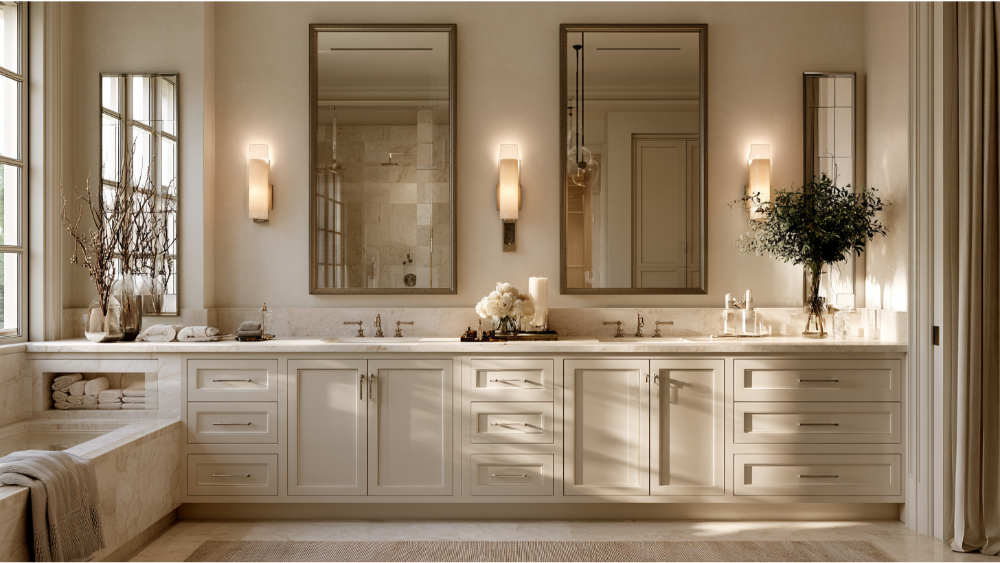
The vanity sets the tone of the whole bathroom, and it’s also where homeowners feel the cost difference most directly. A pre-fab vanity arrives as a finished box in standard widths, usually 24, 30, 36, 48, or 60 inches, often with the top already attached. Pre-fab vanities are the budget-friendly route, they ship quickly, and in a guest bathroom with a straightforward wall, they’re a perfectly sound choice.
The tradeoff shows up in odd rooms. If your wall measures 41 inches, a stock vanity leaves you with filler panels and wasted storage. Semi-custom vanities give you more door styles and drawer configurations while still working from set sizes. Custom vanities are built to the actual dimensions of your bathroom, which means the drawers clear the plumbing, the toe kick meets your new flooring cleanly, and the countertop overhang is intentional rather than accidental.
Our DreamLine Custom Cabinetry is manufactured in-house, so the sizing follows the space instead of forcing the space to follow a stock box. Custom vanities also let us solve storage problems that pre-fab vanities can’t: a drawer bank sized for your hair tools, a tilt-out hamper, or a full-height linen tower in a bathroom that never had one. Every DreamLine vanity carries a limited lifetime warranty, which matters in a room that lives with humidity every single day and earns back its investment through daily use. Higher-end vanity tops in quartz or Dekton get fabricated in the same shop, so one team owns the fit.
Why Does a Small Bathroom Cost So Much to Remodel?
Because square footage is a poor way to price a bathroom. A 5-by-8 guest bath concentrates plumbing, electrical, ventilation, waterproofing, tile, flooring, glass, and finish carpentry into the smallest room in the house. Nearly every trade that shows up for expanded primary bathrooms also shows up in a small bathroom, and each one still has to mobilize, set up, protect the space, and come back for inspection.
Tight quarters can actually slow the work down. Two trades can’t share a 40 square foot room, so a small bathroom renovation often runs sequentially where a larger project could overlap. Fixture count, wet-area complexity, and site access drive your cost far more than floor area does.
What Should Be Included in a Complete Bathroom Remodel Estimate?
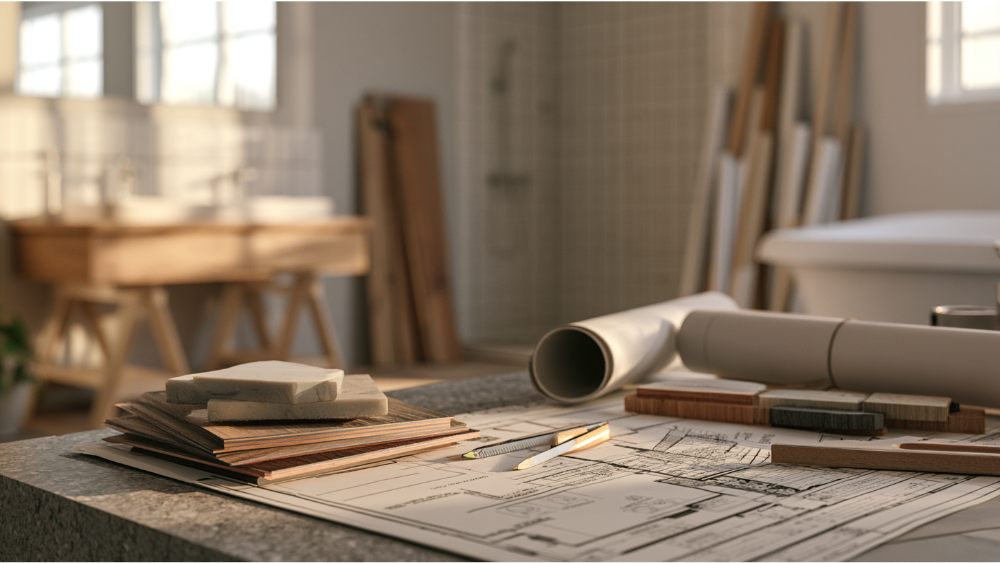
Most budget surprises trace back to something that was never in the estimate. Before you sign anything, confirm the proposal addresses all of this:
- Design and drawings
- Permits, permit fees, and who pulls them
- Demolition and debris removal
- Protection of adjacent living space
- Plumbing and electrical work
- Ventilation
- Framing and wall repair
- Waterproofing system (named, not implied)
- Tile and flooring materials plus installation
- Vanity, countertop, and storage
- Plumbing fixtures
- Shower glass
- Paint and finish work
- Inspections
- Final cleanup
- Written allowances and exclusions on all materials
- Concealed-condition procedure
- Written change-order process
- Warranty terms
When you compare bids, normalize them to identical scope first. A lower bottom line almost always means something above was left out of it.
Do You Need Building Permits for a Bathroom Remodel in Concord?
Usually, yes. The City of Concord’s “Work Requiring a Permit” bulletin lists bathroom remodels as permit-required for both new and replacement work, and it specifically lists shower and tub enclosures as well. Plumbing permits apply to shower, bathtub, and sink work, and moving a faucet or toilet triggers permitting on its own. That’s stricter than the common online claim that same-location replacements are always exempt.
Don’t plan around a flat permit fee you read somewhere. Concord’s current fee schedule governs, and the city directs applicants to its fee estimator and Permit Pal because charges vary with project scope and valuation. Concord also enforces the 2025 California Building Standards Code, effective statewide January 1, 2026. Electrical permits come into play when a bathroom renovation adds circuits, and mechanical permits apply when ventilation is added or upsized.
Check who has jurisdiction before you assume. A property inside city limits goes through the City of Concord Permit Center; unincorporated Contra Costa County follows the county process. San Francisco, the Peninsula, and San Jose each run their own permits, fees, and inspection schedules, and Bay Area cities rarely match one another, so a budget built on one city’s numbers won’t transfer cleanly to the next. Fixture selections matter here too: California Energy Commission standards cap toilets at 1.28 gallons per flush, showerheads at 1.8 gallons per minute at 80 psi, and bathroom faucets at 1.2 gallons per minute. We handle permits in-house as part of our design-build process, so this doesn’t land on you.
California Rules That Protect Your Remodeling Budget

Unclear allowances, verbal add-ons, and front-loaded payments are how budgets come apart. California law gives you real leverage:
- A CSLB license is required when work needs permits, uses workers, or when labor plus materials total $1,000 or more. Verify any contractor through the CSLB license lookup.
- A written contract is required for home improvement work over $500.
- The down payment cannot exceed $1,000 or 10% of the contract price, whichever is less.
- Progress payments should never exceed the value of work completed or materials delivered.
- Change orders should be written and signed before the extra work happens.
- You have a three-day right to cancel, or five days if you’re 65 or older.
For the record: CSLB License #853669, EPA Lead-Safe Certified, A+ BBB Accredited, family-owned since 2001, and 19,000+ homeowners served. Every remodel carries our 24-month labor warranty, and DreamLine Custom Cabinetry carries a limited lifetime warranty.
Hidden Costs in Older Bay Area Homes
East Bay housing stock hides things, and older homes are where outdated systems surface once the walls open. Water-damaged subfloor under a 40-year-old shower pan. Corroded galvanized supply lines. Cast iron drains at the end of their life. Ungrounded or undersized wiring. Structural issues in framing that rotted quietly for years. Prior work that was never permitted and never inspected. None of it is visible until demolition day.
Most planning guides suggest holding a contingency of 10% to 20% of your budget, and 10% to 15% is the common recommendation. Honest contractors can’t price what nobody can see yet. What a good contractor can do is spell out in the contract how concealed conditions get documented, priced, and approved in writing before the work proceeds.
If your home was built before 1978, the EPA’s Renovation, Repair and Painting rule applies. The minor-repair exception generally covers no more than six square foot of disturbed painted surface per interior room, and a full bathroom demolition will normally exceed that. We’re an EPA Lead-Safe Certified firm, so trained renovators and lead-safe work practices are built into how we run those projects.
How to Control Cost Without Compromising Craftsmanship
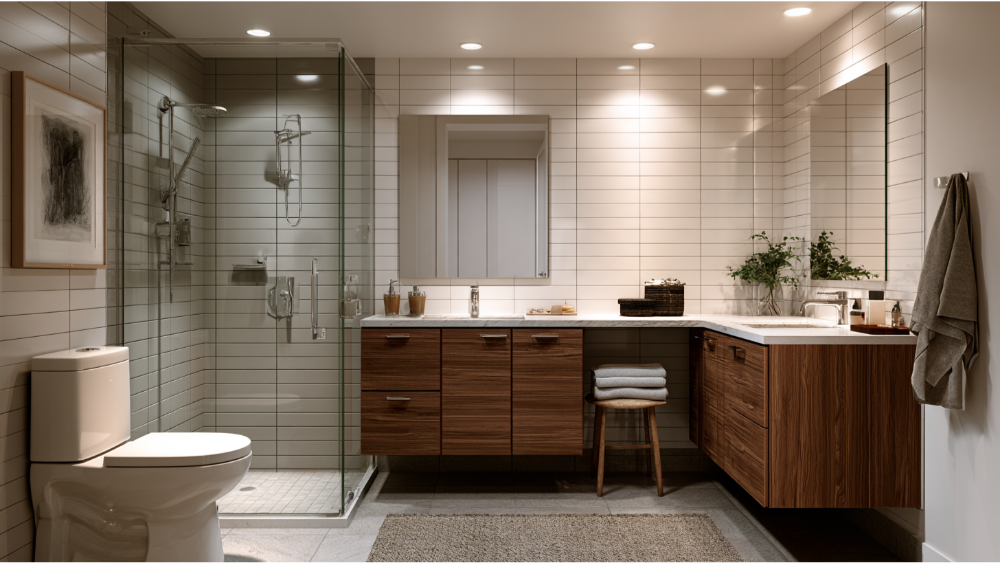
Keep the layout if it still functions. That single decision saves more than any material substitution you’ll make later.
Spend where failure is expensive and save where it’s cosmetic. Waterproofing, wet-area installation, and ventilation are permanent and buried. Design elements like tile pattern, mirror style, and hardware finish are not. Well-made porcelain tile in a straightforward layout looks excellent and installs efficiently, and porcelain flooring in a large tile format reads as higher-end without a higher-end price.
Lock Your Selections During the Design Phase
Finalize your tile, flooring, vanity, and fixtures during the design phase, before demolition begins. Selections made mid-project as change orders are the most expensive selections you’ll ever make, because they stall the crew and reshuffle the schedule. The design phase is also when custom vanities and stone tops get measured and queued for fabrication, which protects your timeline. Separate must-haves from nice-to-haves on paper, and if the rest of the room is fine, consider a targeted tub-to-shower conversion instead of a full gut.
Our Bathroom Visualizer Tool and our 20,000-square-foot Grand Kitchen and Bath Showroom exist so you can decide early instead of guessing. On DIY: handling your own demolition help is reasonable. Waterproofing and plumbing are not places to experiment.
How Long Does a Bay Area Bathroom Renovation Take?
Local market estimates put active construction at roughly three to five weeks for a straightforward same-layout project, and six to ten weeks when plumbing moves, walls change, or a curbless shower is involved. Those are market estimates, not guarantees.
Expect additional time on the front for the design phase and material selection, permits and plan review, and material lead times on anything ordered or fabricated. Add time on the back for inspections, custom glass templating, and punch list. Inspection scheduling, custom fabrication, and hidden damage all move the date. Our one-day bathroom remodel is a specific named service for qualifying projects, and it doesn’t apply to a full remodel.
Why One Accountable Design-Build Team Matters to Your Budget

Cost overruns rarely come from one bad decision. They come from gaps. The designer assumes the plumber handles it. The plumber assumes the tile setter does. Nobody owns it, and you get a change order.
Design, permits, material procurement, cabinetry manufacturing, stone fabrication, and installation all happen under one roof here, with our own crews. That doesn’t automatically make us the lowest number on your desk. What it does give you is a clearer scope up front, clear communication between everyone touching the job, and one contract with one company responsible for the outcome. We’ll never send you searching for another contractor to finish what we started. Every remodel carries a 24-month labor warranty, and DreamLine Custom Cabinetry carries a limited lifetime warranty.
Frequently Asked Questions
These are the most common questions we hear from homeowners pricing a project.
Can I renovate a bathroom for $10,000 in the Bay Area?
For cosmetic work, yes. Paint, a new mirror, light fixtures, a toilet, a pre-fab vanity, and sometimes flooring can fit that range. Demo-to-studs work with new waterproofing and tile is not realistic at that figure given local labor rates.
What is the 30% rule in remodeling?
It’s a budgeting guideline suggesting you avoid investing more than about 30% of your home’s value into a single renovation. It’s a planning guardrail, not a code or a lending requirement. Bay Area home values make it far less restrictive here than in most of the country.
Is $5,000 enough to remodel a bathroom?
That’s a refresh budget: new fixtures, paint, mirror, lighting, hardware, and possibly one of the smaller pre-fab vanities. It won’t cover demolition, new waterproofing, retiling a shower, or any permitted plumbing or electrical work.
What does a $10,000 bathroom remodel look like?
Refreshed surfaces and fixtures in the existing layout. No plumbing moved, off-the-shelf materials, minimal new tile. It can look genuinely good, and the room will function the same way it did before.
Does a bathroom remodel need a general contractor?
Any permitted bathroom renovation in California needs a licensed contractor, and a project that touches plumbing, electrical, framing, and finishes needs someone coordinating all of it. A design-build team handles both roles at once, which removes the handoffs where cost usually leaks.
Get a Real Number for Your Bathroom, Not a Range
The fastest way past all these ranges is to have someone measure your space and define the scope with you. Book a free consultation and we’ll build an itemized estimate covering design, permits, materials, labor, and inspections.
Call (916) 701-9660 to Schedule a Free Consultation, or visit our 20,000-square-foot Grand Kitchen and Bath Showroom in North Highlands to see and touch the materials before you decide.
Last updated: September 2026. Permit requirements, code editions, and market data are reviewed annually.