Key Takeaway
The average bathroom remodel costs between $7,000 and $15,000 for most homeowners, based on 2025 national survey data, though a standardized midrange 5-by-7 professional remodel benchmarks at $26,138 and full gut renovations regularly exceed $40,000. The right number depends on your bathroom type, how much of the layout you change, and your material choices. Published averages describe a range of projects, not yours specifically.
There isn’t one average, and that’s the honest starting point. National cost guides cluster around $12,000, homeowner-reported spending for projects finished in 2025 came in at a $7,000 median for guest bathrooms and $15,000 for primary bathrooms, and the standardized midrange 5-by-7 professional remodel benchmarks at $26,138. Every one of those numbers is measuring a different project.
If you’re sitting at the kitchen table trying to figure out whether a bathroom remodel is realistic before you call anyone, this article will help you find the number that actually applies to your bathroom, and explain what moves it. Published bathroom remodel costs are a frame of reference, not a quote.
One note up front: every figure here comes from independent national research. None of it is our pricing. Your bathroom size, your home’s condition, and the materials you choose decide your estimate.
How Much Is the Average Bathroom Remodel in 2026?
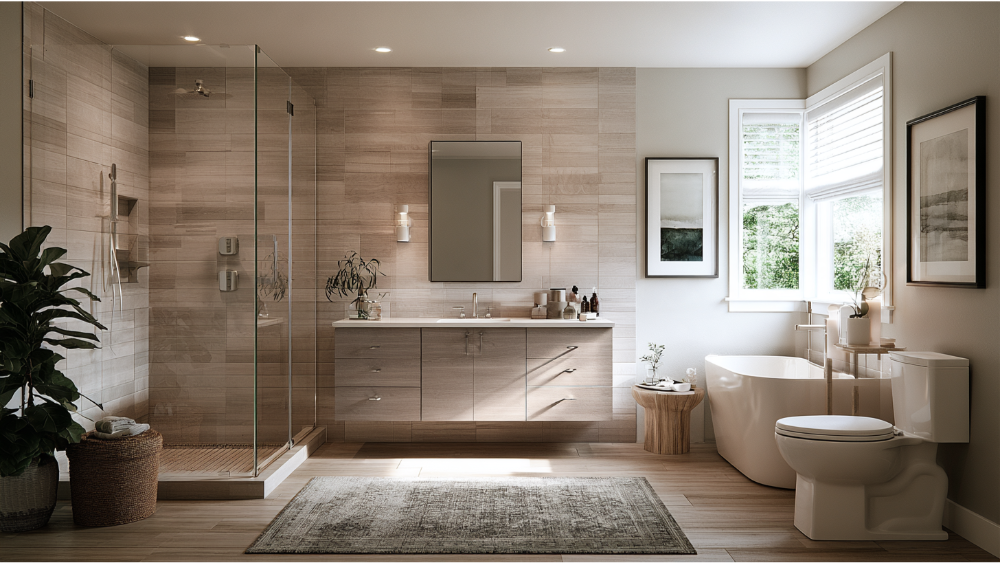
Here are the published benchmarks side by side, with what each one is actually measuring.
| Figure | What it measures | Source and year |
|---|---|---|
| $7,000 | Median homeowner spend, guest bathroom remodel | Houzz & Home study, projects completed 2025 |
| $15,000 | Median homeowner spend, primary bathroom remodel | Houzz & Home study, projects completed 2025 |
| $18,000 / $30,000 | Median for major primary remodels under 100 sq ft / 100+ sq ft | Houzz & Home study, 2025 |
| $50,000 | 90th percentile spend, all primary bathroom remodels | Houzz & Home study, 2025 |
| $26,138 | One tightly defined midrange 5-by-7 professional remodel | 2025 Cost vs. Value Report |
| $81,612 | Standardized upscale bathroom remodel | 2025 Cost vs. Value Report |
| $42,183 | Standardized universal design (accessible) bathroom remodel | 2025 Cost vs. Value Report |
| ~$12,000 | Blended average across minor, partial, and full projects | General consumer cost guides, current |
| $6,639 to $17,621 | Common reported range for typical projects | General consumer cost guides, current |
Look at that table for thirty seconds and the confusion resolves itself. A guest bath remodel where someone swapped a vanity and retiled the floor sits in the same dataset as a gut bathroom renovation with a curbless custom shower. Averaging them produces a number that describes nobody’s project.
A fair general answer: most homeowners doing a real bathroom remodel land somewhere between roughly $6,000 and $18,000, with homeowners spending as little as $3,000 to $10,000 on budget-tier cosmetic work and full gut renovations frequently exceeding $40,000. Those cost ranges narrow fast once you define two things: which bathroom, and how much of it you’re changing.
We don’t publish price ranges for our own work, and we won’t. Scope, existing conditions behind the walls, and your selections change the overall project cost too much for a web page to be honest about it. What we do instead is walk your bathroom, document what’s there, and give you a written estimate for free.
Why Do Published Bathroom Remodel Costs Disagree So Much?
Three methodology differences explain almost all of the spread you see when you search bathroom remodel costs.
Average vs. median, two different numbers
An average is pulled upward by outliers. A handful of $80,000 projects in a dataset will drag the mathematical average well above what most people spent. A median splits the group in half: half spent more, half spent less. Houzz reports medians. Most consumer cost guides report averages. That alone accounts for a several-thousand-dollar gap in reported project cost before anyone talks about tile.
Homeowner-reported spending vs. standardized contractor benchmarks
The 2026 Houzz & Home study surveyed 20,358 U.S. respondents, including 10,176 who renovated a primary residence in 2025, and reports what those homeowners said they spent. The Cost vs. Value midrange figure is something else entirely: one specific project (a 5-by-7 existing bathroom, 30-by-60 tub, ceramic tile surround and floor, standard toilet, solid-surface vanity top, medicine cabinet) priced using federal wage and material data plus local estimating data across 119 markets. It’s a fixed recipe, not a survey. Both numbers are legitimate. They just aren’t comparable.
DIY bathroom work, national averages, and your ZIP code
Some datasets blend DIY bathroom projects with professional ones. When a homeowner tiles their own shower, the reported project cost drops even though the work still happened, which pulls published labor figures down. National figures also flatten real differences in labor rates, permitting, and code requirements from one market to the next. Metros dealing with skilled labor shortages carry higher labor costs than a national line item suggests. Taking a national average and multiplying it by a guessed “California premium” is not an estimate. It’s a coin flip with extra steps.
Average Bathroom Remodel Cost by Bathroom Type
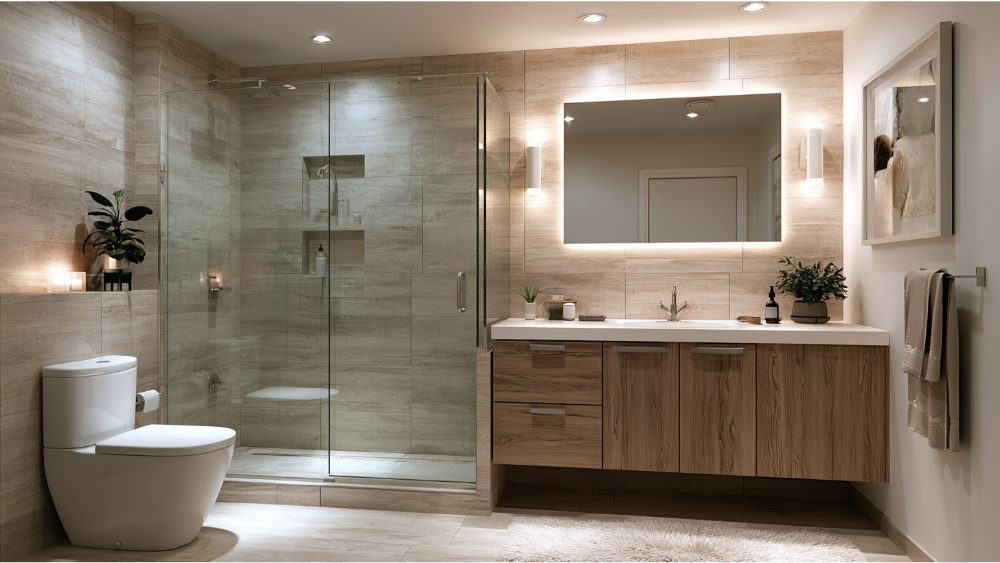
Bathroom type is the single fastest way to narrow the cost ranges, because it determines whether there’s a shower assembly involved at all.
Powder room and half bath remodels
No tub, no shower, no waterproofing system, no shower valve. That removes the most expensive assembly in the room. Published figures for a half bath remodel typically run $2,000 to $6,000 and cover a vanity, toilet, floor tiles, lighting fixtures, and paint. Powder rooms are also where homeowners often splurge on a statement material, since the square footage is small enough to keep high material quality affordable.
Guest and hall bathroom remodels
The 2025 national median spend for a guest bath remodel was $7,000. These projects usually mean a bathtub replacement or a tub-to-shower conversion, a new vanity, tile, and fixtures, with the layout staying exactly where it is. It’s the most common bathroom remodel in the country and the most predictable to budget.
Primary bathroom and master bathroom remodels
The 2025 median for a master bathroom remodel was $15,000, but the 90th percentile hit $50,000. That spread is real, not noise. A master bathroom is where dual vanities, custom tile walk-in showers, freestanding tubs, and larger tiled surface area all show up. It’s also where rain shower heads, body sprays, and luxury fixtures tend to enter the conversation. Every one of those decisions is optional, and every one moves the project cost.
If you’ve been searching “master bathroom” and finding “primary bathroom” data, it’s the same room. The industry changed the term. The cost data didn’t change with it.
Small vs. large master bathrooms (the bathroom size effect)
Among major primary bathroom remodels in 2025, bathrooms under 100 square feet had a median of $18,000. Bathrooms at 100 square feet or more: $30,000. More square footage means more tile, more waterproofed area, more labor hours, and usually a larger shower. Bathroom size doesn’t scale cost neatly, but at the major-remodel level it clearly produces higher costs.
What Counts as a “Typical Bathroom Remodel”? Five Scope Levels
This is the other half of the answer. Two neighbors can both say they remodeled a bathroom and mean completely different things.
Cosmetic refresh
Paint, mirror, lighting fixtures, hardware, maybe a vanity swap that reuses the existing plumbing connections. Nothing opens up. Published budget-tier figures of $3,000 to $10,000 mostly describe this tier, and it’s the most affordable bathroom update a professional will bid. Fastest to complete, easiest to predict.
Partial remodel and tub replacement
Bathtub replacement, a new shower enclosure or wall surrounds, a new vanity or countertop, with the existing layout untouched. This is where our tub-to-shower conversions, walk-in tub installations, and one-day bathroom remodel service live. Turning an unused tub into one of the low-threshold walk-in showers homeowners ask for most often falls into this tier. That one-day service applies specifically to qualifying tub, shower, and surround projects. It is not a claim about a full custom bathroom renovation.
Full remodel on the existing layout: the midrange bathroom remodel
Demo to the studs, new waterproofing, tile shower, new fixtures, new vanity, updated electrical and ventilation, with the plumbing staying where it is. Mid range bathroom remodels cluster here, closest to the $26,138 benchmark, and this is what most people picture when they say “bathroom remodel.”
Full gut renovation with a new floor plan
Relocated plumbing, moved walls, a larger custom shower, sometimes borrowed closet space from an adjacent room. Highest variability by far. Published bathroom renovation costs for this tier regularly exceed $40,000, and the standardized upscale benchmark averages $81,612 nationally. A high end renovation belongs in this category, and luxury remodels with imported stone and fully custom glass sit above the benchmark rather than near it.
Bathroom additions and ADUs
Adding a bathroom where none existed means new framing, new drain and supply lines, and sometimes a look at your home’s service capacity. It belongs in its own category and shouldn’t be compared to any remodel average. If that’s the direction you’re heading, our room addition and ADU work is a different conversation with a different scope document.
What Does a Bathroom Remodel Cost Per Square Foot?
Published per square foot figures for bathroom remodels generally run $70 to $250. Here’s why cost per square foot is the weakest planning metric in the whole category.
Bathrooms carry enormous fixed costs. One toilet, one shower valve, one exhaust fan, one waterproofing system, one permit. Those cost roughly the same whether the room is 40 square feet or 90 square feet. So a small bathroom remodel often costs more per square foot than a large one, which is the opposite of what the metric implies. A 35 square foot hall bath with a custom tile shower can land at the top of that per square foot range, while a 120 square foot master bathroom with a simple layout and a stock vanity lands near the middle.
Use the per square foot number to sanity-check a figure someone hands you. Don’t use it to build your total remodeling budget. Square footage tells you how much floor and wall area you’re covering. It tells you nothing about how many trades the total cost has to carry.
Labor Costs vs. Material Costs: Where Does the Money Go?
Across published research, the typical bathroom remodel cost breakdown puts labor at roughly 40% to 65% of the budget, with materials making up the remaining 35% to 60%. The ratio swings hard depending on what you choose. A tile-heavy custom shower tips toward labor. A natural stone and designer-fixture package tips toward materials.
What drives labor costs
Demolition costs and debris disposal, plumbing and electrical rough-in, waterproofing, tile setting, glass installation, plus the coordination and inspection time nobody photographs. Curbless walk-in showers are especially labor-heavy, because the floor has to be recessed or built up and sloped correctly before a single tile goes down. Installation complexity, more than material price, is what separates a two-week bathroom from a six-week one. On a typical project, that’s four or five trades that all have to show up in the right order. We handle design, permitting, fabrication, and installation in-house, under one contract, which means the sequencing is our problem instead of yours.
What drives material costs
Tile and natural stone selection, the vanity and countertop, shower systems and glass, and fixtures. Countertop material alone swings widely across quartz, Cambria, Silestone, Dekton, and natural stone. Premium materials aren’t the right call in every room, but quality materials in the places that stay wet and get touched daily are where the money earns its keep. We build DreamLine Custom Cabinetry ourselves and fabricate stone in our own shop, which gives us direct control over what goes into your bathroom and how it’s cut to fit.
What Affects Bathroom Remodel Costs the Most?
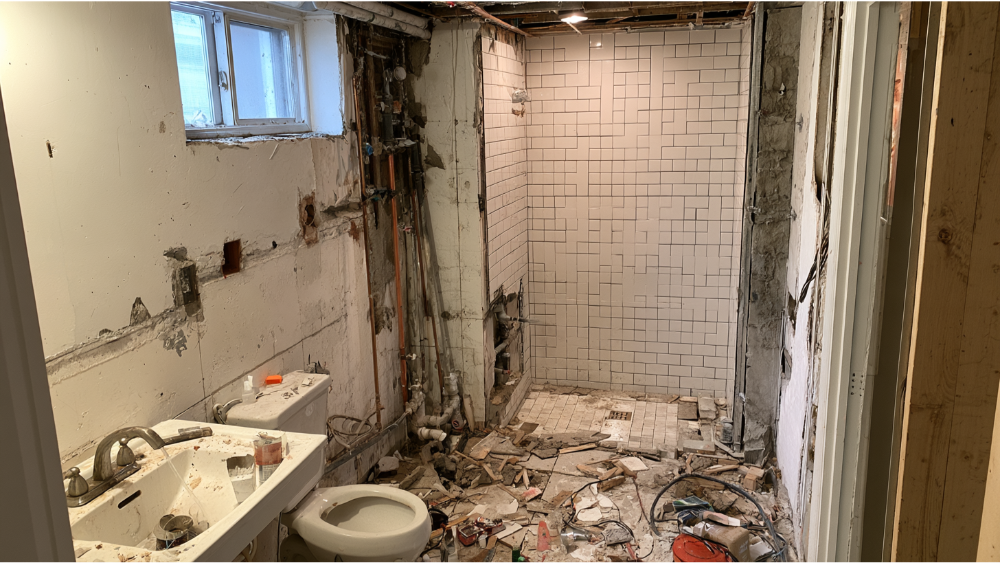
Roughly in order of impact.
Whether you change the floor plan
Biggest lever, by a wide margin. Keeping fixtures where they are commonly saves $3,000 to $10,000. Moving a toilet or shower drain means opening the bathroom floor and, in a lot of homes, the ceiling of the room below it, plus additional plumbing inspections.
The shower or tub decision
Published shower installation figures span $300 to $15,000. That’s the difference between an acrylic surround over an existing pan and a fully custom tile shower with curbless entry, a linear drain, and frameless glass shower doors. Walk-in showers cover that entire span, which is why the phrase alone tells a contractor almost nothing until you describe the pan, the glass, and the tile. This one decision moves the total cost more than any finish selection you’ll make.
Waterproofing and what’s behind the bathroom walls
The pan, the membrane, the backer board, the substrate prep. None of it shows up in the after photos, and all of it determines whether the tile work lasts fifteen years or fails in three. It’s also where rot and mold growth get discovered after demolition starts.
Hidden damage and outdated systems
Galvanized supply lines and other outdated plumbing, undersized drains, ungrounded wiring, previous unpermitted work. Older homes across the Sacramento area turn up at least one of these regularly, and each one carries higher costs the later it surfaces. We inspect existing conditions and document scope before demolition so surprises become line items early instead of change orders late.
Vanity, storage, and custom cabinetry
Stock vanities are published at roughly $525 to $2,940. Custom cabinetry costs more and fits the room exactly, which matters a lot in bathrooms with odd angles or tight clearances. Solid wood doors and drawer fronts cost more than laminate and hold up better in a room that gets steamy twice a day. Our DreamLine Custom Cabinetry is made in America and carries a limited lifetime warranty.
Tile, natural stone, and bathroom floors
Bathroom floors are commonly published at $700 to $4,200. Standard subway tile, large-format porcelain tile, and natural stone differ in material price and in setting labor, since bigger and heavier formats take longer per square foot and demand a flatter substrate. Heated floors add both an electrical circuit and floor buildup to the scope.
Electrical, lighting fixtures, and ventilation
A dedicated 20-amp circuit, GFCI protection, an exhaust fan ducted to the outdoors, and layered lighting at the vanity and shower. Rarely photographed. Always inspected.
Permits, inspections, and accessibility features
Permits are commonly cited nationally at $100 to $1,000 and are generally required when you touch structure, plumbing, or electrical. Accessible remodels benchmark near $42,183 in the standardized data, because blocking for grab bars, curbless walk-in showers, wider doorways, and reinforced framing all add real work.
What Should a Bathroom Remodel Estimate Include?
Two estimates can be thousands of dollars apart and describe completely different work. The gap usually isn’t markup. It’s missing line items. Here’s what a complete bathroom remodel estimate should account for:
- Design, measurements, and drawings
- Plans and permit applications
- Demolition and debris disposal
- Jobsite protection (floors, adjacent rooms, dust control)
- Plumbing rough-in and fixture connections
- Electrical, including circuits and GFCI protection
- Ventilation and exterior ducting
- Shower waterproofing system
- Wall and floor substrate preparation
- Tile and setting materials
- Vanity, countertop, and fabrication
- Fixtures, faucets, and trim
- Shower glass
- Painting and trim carpentry
- Material delivery and storage
- Final cleanup
- Inspection scheduling and coordination
- Change-order process and pricing rules
- Labor warranty and product warranties
Then ask the question most homeowners skip: what is excluded? Get the answer in writing. Shower glass, permit fees, and paint are the three most commonly omitted items, and all three come back later at full price. Every one of them belongs in the project cost from day one.
Our estimates come from a single contract with one accountable team, so there’s no gap between trades where a line item can quietly disappear.
How Often Do Bathroom Remodels Go Over Budget?
Among homeowners who renovated in 2025, 75% started with a budget. Of those, 37% exceeded it, 35% finished on budget, and 3% came in under. So roughly two in five projects went over, which is common enough that you should plan for it inside your remodeling budget rather than hoping around it.
The reported causes:
- Products or services cost more than expected: 52%
- Chose more expensive materials than planned: 35%
- Project was more complex than expected: 32%
- Changed the scope or design mid-project: 31%
- Unexpected construction conditions: 22%
Read that list again. Four of the five are planning issues, not bad luck. Finalize your design before demolition, lock your selections before ordering, and make sure existing conditions get inspected in advance where access allows. Then hold 10% to 20% of your overall remodeling budget in contingency for the 22% category, because nobody sees through a wall.
How to Save Money on a Bathroom Remodel Without Compromising Craftsmanship
Eight moves that actually work:
- Keep the existing layout. Leaving plumbing where it sits commonly saves $3,000 to $10,000.
- Refresh what’s sound instead of replacing it. If cabinet boxes are solid, cabinet refacing is a legitimate alternative to full replacement.
- Spend where you touch it daily. Waterproofing, the shower valve, the faucet, the vanity hardware. Quality materials belong there. Economize on decorative accents you’ll want to change in five years anyway.
- Choose porcelain that reads like natural stone. Large-format porcelain has gotten convincing, and it’s easier to maintain in a wet room.
- Lock selections early. Mid-project changes are the 31% line in the overrun data.
- Separate must-haves from phase-two upgrades. Heated bathroom floors can be added later. A relocated drain cannot.
- Watch material sales, especially on fixtures and tile with long-standing availability, and compare a home improvement store sample side by side with a showroom sample before you decide.
- Ask about flexible financing. We offer options and current promotions, and plenty of homeowners also weigh home equity loans before they commit. The specifics are best covered during a free consultation.
An affordable bathroom remodel is a scope decision more than a materials decision. Narrowing what you change protects the parts of the room that have to last.
Where a DIY bathroom remodel saves money and where it backfires
Doing your own work can cut labor by 30% to 50%, and painting or demolition are reasonable places to start a DIY bathroom project. Plumbing, electrical, and waterproofing are where DIY failures get expensive, because the damage shows up behind finished tile and the repair means undoing work you already paid for twice. In California, a contractor’s license is generally required once a permit is involved or labor and materials total $1,000 or more, so know which side of that line your project sits on.
How Long Does a Bathroom Remodel Take?
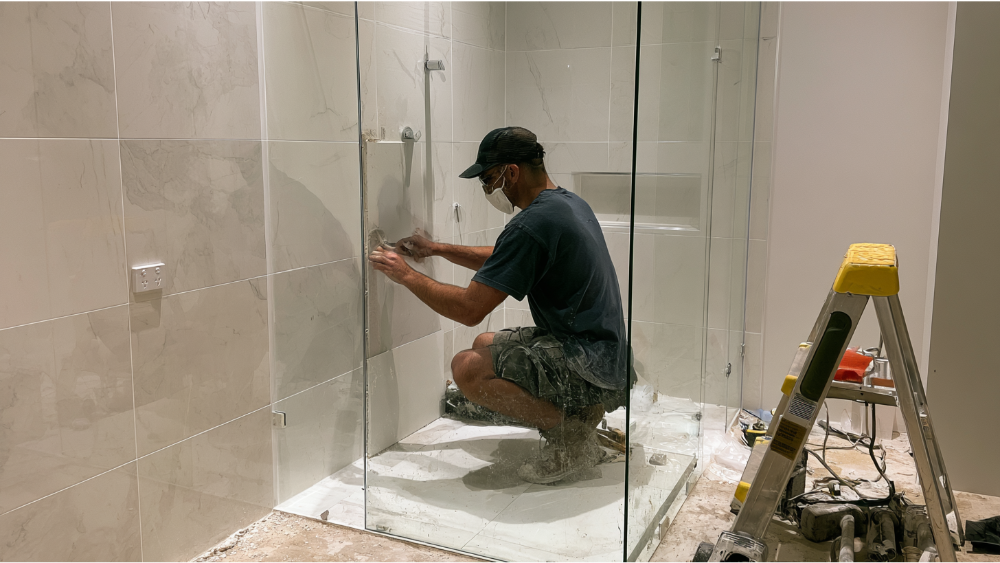
For primary bathroom projects completed in 2025, homeowners reported averaging 8.4 months of planning and 4.8 months of construction. Those are broad national survey averages across every project size, not a forecast for your bathroom. The planning figure surprises people, but it reflects real behavior: homeowners spend months deciding before they commit.
What actually moves a construction schedule: permit review time, product lead times, custom fabrication, inspection availability, and change orders. Also worth knowing, 84% of bathroom renovators hired at least one professional, 61% upgraded ventilation, heating, or plumbing systems, and 36% changed their layout. Layout changes and system work both extend timelines and both raise the project cost.
Our one-day bathroom remodel applies to specific qualifying services (tub and shower conversions, replacements, and wall surrounds). A full custom bathroom renovation is a different project with a different schedule, and we’ll give you a real one before we start.
Do You Need a Permit for a Bathroom Remodel in Roseville, California?
Usually, yes. Anything involving plumbing, electrical, or major structural changes requires a permit. The 2025 California Building Standards Code took effect January 1, 2026, and governs current applications. Roseville handles residential remodel permits through its Online Permitting Services portal, with a submittal checklist (last revised April 22, 2026) that can require architectural, structural, plumbing, mechanical, electrical, energy, and green-building plan elements depending on scope.
Roseville will provide a project-specific permit fee estimate free of charge, generally within 15 business days of receiving your project information. That’s a far better number than any generic permit figure you’ll find online.
Roseville code requirements that can change your scope
- Shower interior of at least 1,024 square inches, able to contain a 30-inch-diameter circle
- Shower door clear opening of at least 22 inches
- At least one receptacle within 3 feet of each sink basin
- A dedicated 120-volt, 20-amp bathroom receptacle circuit, with GFCI and tamper-resistant devices
- Mechanical exhaust of 50 CFM intermittent or 20 CFM continuous, vented outdoors, even with an operable window
- Maximum shower and tub filler temperature of 120°F
- Fixture flow limits: 1.2 GPM faucet, 1.28 GPF toilet, 1.8 GPM showerhead
That last line means low flow toilets and showerheads are the baseline in a compliant remodel, not an optional green upgrade. These requirements are also exactly why a compliant estimate includes electrical and ventilation work you may not have budgeted for. A proposal that skips them isn’t a lower price. It’s an incomplete one.
Homes built before 1978
The EPA’s Renovation, Repair and Painting Rule generally applies when paid contractors disturb painted surfaces in pre-1978 homes. Demolition of painted surfaces and window replacement remain covered regardless of the square footage involved. We’re an EPA Lead-Safe Certified Firm, which matters across the older neighborhoods we work in throughout Roseville and greater Sacramento.
How to Compare Bathroom Remodel Contractors Safely
Before you compare numbers, compare what’s behind them:
- Verify the CSLB license number on the state’s website, not on the contractor’s business card
- Confirm current liability and workers’ compensation insurance
- Get the written scope and the written exclusions
- Ask whether the bid was built line by line or estimated per square foot, because the second method hides assumptions
- Confirm in writing who pulls the permits
- Ask who physically performs each phase and who schedules inspections
- Compare warranties on labor and on products separately
- Know the law: in California, a home improvement down payment cannot exceed $1,000 or 10% of the contract amount, whichever is less
Why the lowest number is not always the lowest cost
A missing line item is a future change order, priced after you’ve already committed and the wall is open. The only fair comparison of bathroom remodel costs is the same scope, line for line, with the same exclusions. When one bid is dramatically lower, find the difference before you assume you found a deal.
For our part: CSLB License #853669 (B, C17, C36, C10, C-61/D41, C15, C54, D06), EPA Lead-Safe Certified, A+ BBB Accredited, and a 24-month labor warranty on all remodels.
Is a Bathroom Remodel Worth the Money?
By the resale math, the standardized midrange bathroom remodel recouped an estimated 80% of its cost in the 2025 report. The upscale version recouped about 41.7%, and the accessible remodel about 61.2%. Minor refreshes generally land in the 70% to 80% range.
That’s one measure. The other is the fifteen minutes you spend in that room every single morning for the next decade. A bathroom is a major investment, and one you enjoy has value a spreadsheet won’t capture. If you want the resale side in detail, we covered it in our article on how much a bathroom remodel increases home value.
What Our In-House Design-Build Process Changes About Your Estimate
We won’t tell you the in-house model is the lowest price. We’ll tell you it makes the estimate easier to understand and harder to get wrong.
Given that 61% of bathroom renovators touch ventilation, heating, or plumbing systems, a bathroom remodel is a multi-trade job whether or not anyone tells you that up front. We’re family-owned and have been doing this since 2001, with more than 19,000 homeowners served. Design, permitting, material procurement, fabrication, and installation all happen under one roof, on one contract. We build DreamLine Custom Cabinetry and fabricate stone in our own shop. Every remodel carries a 24-month labor warranty, and DreamLine cabinetry carries a limited lifetime warranty.
If you can’t picture it yet, that’s normal. Our 20,000-square-foot Grand Kitchen and Bath Showroom in North Highlands is the largest of its kind in the region, and our Bathroom Visualizer Tool lets you try combinations before you commit to anything.
Frequently Asked Questions
Can you renovate a bathroom for $10,000?
For many guest and hall bathrooms, yes. The 2025 national median for guest bathroom remodels was $7,000, and budget-tier bathroom remodel costs are commonly published at $3,000 to $10,000. It generally means keeping the existing layout and choosing standard fixtures and tile.
What does a $10,000 bathroom remodel look like?
Same footprint, new vanity and countertop, a tub replacement or shower surround, new floor tiles, a new toilet, updated lighting fixtures, and paint. That’s a cosmetic-to-partial scope. It doesn’t include a gut bathroom renovation with relocated plumbing or a custom tile shower.
How much more does a master bathroom remodel cost than a guest bath?
Roughly double at the median, $15,000 against $7,000 in the 2025 data, and the gap widens at the major-remodel level. A master bathroom is simply a bigger room with more fixtures, more tiled area, and more of the upgrades people want most.
What is the biggest expense in a bathroom remodel?
Labor overall, at 40% to 65% of the budget. Within materials, the shower or tub assembly dominates: waterproofing, tile or surround, valve, and glass. A custom tile shower is usually the single largest line item on the estimate.
Is cost per square foot a reliable way to budget?
Not on its own. Fixed costs like the permit, the valve, and the exhaust fan don’t shrink with the room, so small bathrooms often come in higher per square foot. Treat it as a cross-check, not a planning tool.
Does keeping the same floor plan really save money?
Yes. Keeping plumbing in place commonly saves $3,000 to $10,000 by avoiding drain relocation, opening the floor and the ceiling below, and the additional inspections that come with it.
Get a Real Number for Your Bathroom, Not a National Average
Averages are useful for deciding whether to start. They’re useless for deciding what to build. Let us walk your bathroom, look at what’s behind the walls, and put a real scope in writing for you at no cost.
Call (916) 701-9660 to Schedule a Free Consultation, or come Visit Our Showroom in North Highlands and put your hands on the tile, stone, and DreamLine cabinetry. We serve Roseville and the greater Sacramento area.