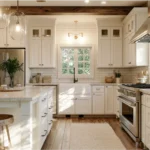

Key Takeaway
DreamLine custom cabinetry is designed and built to your room’s exact measured dimensions, while stock cabinets come in fixed increments that force your kitchen to adapt around them. For Sacramento-area kitchens with angled walls, panel-ready appliances, or specific storage needs, custom cabinets from DreamLine eliminate dead corners and wasted space. When the layout is simple and catalog finishes satisfy the design, stock or semi custom cabinets remain a practical, cost-effective choice.
DreamLine Custom Cabinetry is designed and custom built around your room, your appliances, your storage habits and the finish you actually want, instead of forcing your kitchen cabinets to fit a set of predetermined stock sizes. Stock cabinets are still a reasonable choice when the layout is simple, the appliances are standard and the available finishes already suit your plan. Semi custom cabinets sit between the two, giving you a manufacturer’s catalog with a limited menu of changes. The real question is not which cabinet type is “better.” It’s which one solves the problems in your kitchen.
If you’re among the homeowners planning a kitchen remodel and trying to figure out what custom cabinets actually buy you, this is written for you. We’ll be straight about when stock cabinets are enough, because we’ve told plenty of Sacramento and Roseville homeowners exactly that.
DreamLine Custom Cabinetry vs Stock Cabinets and Semi Custom Cabinets at a Glance

The differences between cabinet types show up less on the showroom floor and more on installation day, when the walls turn out to be slightly out of square and the refrigerator opening is a half inch tight. Here’s how the three approaches compare across the things that actually matter once cabinets are hung.
| Stock Cabinets | Semi Custom Cabinets | DreamLine Custom Cabinets | |
|---|---|---|---|
| How cabinets are sized | Made before your order in fixed increments | Catalog sizes with permitted modifications | Custom built to your room’s measured dimensions |
| Fit of cabinets around walls, corners and ceilings | Room adapts to the modules | Some adjustment available | Planned for the conditions on site |
| Fillers and finished panels | Often used to close gaps | Fewer, still common | Used intentionally, specified in the design |
| Appliance integration | Limited to standard openings | Some panel and opening options | Drawn from appliance spec sheets |
| Interior storage options | Defined accessory list | Broader accessory list | Organizers and pull-outs planned per cabinet |
| Custom doors and finish range | Catalog selections | Wider catalog selections | Four collections including custom paint color |
| Material quality and construction choices | Set by the line | Set by the semi custom line | Selected and documented per project |
| Production timing | Fastest, cabinets often in stock | Moderate | Built for your order |
| Who installs the cabinets | Your responsibility to arrange | Usually a separate installer | Our in-house crews |
| Warranty and service | Varies by manufacturer | Varies by manufacturer | Limited lifetime product warranty, plus our separate 24-month labor warranty on remodels |
| Best fit for | Simple rectangular kitchens | Mostly standard rooms needing a few adjustments | Difficult rooms, specific storage, integrated appliances |
What “Stock,” “Semi Custom,” and “Custom” Cabinets Actually Mean
These three words get used loosely across the industry, and the confusion costs homeowners money. Here’s what each cabinet type actually describes.
Stock cabinets
Stock cabinetry is manufactured before anyone places an order, in predetermined widths, heights and depths, usually in three-inch increments. It’s what you see stacked and on display at a big box store, and you choose from what exists. That’s the whole advantage of stock options: availability, simple purchasing and a lower cabinet cost up front. RTA cabinets, meaning ready-to-assemble, are a subcategory shipped flat and assembled on site or in a shop. The tradeoff is that the room has to be designed around the modules, which is why filler strips show up wherever the math doesn’t work out, and why stock cabinets tend to leave wasted space in corners and above the refrigerator.
Semi custom cabinets
Semi custom cabinetry starts with a manufacturer’s defined system and allows modifications inside set limits. You might change depth, adjust height, pick from a wider door style list or specify a finish that isn’t standard. The catalog still governs which semi custom options exist. Ask what the limits are on any line described this way, because semi custom cabinets from one company can mean far more flexibility than the same words from another. Some semi custom lines will reduce a cabinet in one-inch increments and build a taller upper; other semi custom lines stop at the door style page.
Fully custom cabinets
Fully custom cabinets are designed and produced for the measured space. Custom cabinet makers work from dimensions taken in your house rather than from a chart, so interior configurations, door treatments and finishes get decided for your project instead of being pulled from a fixed list. That’s why a full custom line can absorb an angled wall or a nine-foot ceiling without an apology, and why non standard layouts are where the category earns its keep. DreamLine Custom Cabinetry is our own line of custom cabinets, designed and built in-house and made in America, and our product pages describe it as built from scratch according to what the homeowner asks for.
Labels are marketing. Before you sign anything, ask which dimensions, materials, modifications and finishes are genuinely changeable on the specific cabinets you’re being quoted.
What a Sacramento Kitchen Remodel Actually Gains From DreamLine Custom Cabinets

Six things, in the order they tend to matter to the people who live in the kitchen.
1. Cabinets measured and custom built for your room
Older Sacramento-area homes rarely have perfectly square walls, and newer builds often bring sloped ceilings, awkward corners or ceiling transitions that catalog runs were never drawn for. Custom sizing lets us build cabinets to the conditions we measure. To be clear about what that does and does not mean: intentional fit is not a promise of zero fillers. A scribe, a reveal or a finished panel is frequently the right answer for an out-of-square wall or an appliance clearance. The difference is that every one of those pieces is a decision made in design, not a gap covered up on install day.
2. More usable storage and less wasted space
Extra linear feet of cabinets don’t help if you still can’t reach the stand mixer, and you don’t need fine dining ambitions to want a drawer that opens all the way. Custom planning means deep drawers where you keep pots, pull out shelves in the base cabinets, tray dividers next to the oven, spice racks beside the range, a hidden trash pull-out in the prep zone and pantry cabinets sized to what your family actually buys. Appliance garages keep the counter clear for the toaster and the coffee maker. Specialized storage like that gets planned cabinet by cabinet instead of being patched later with aftermarket organizers that never quite match the opening. Stock cabinets in a tight galley often end up with a dead corner and a shallow void behind a filler, and that wasted space is real money hanging on your wall. Functional storage is what makes a functional kitchen, and we’d rather build fewer, smarter cabinets than a row of doors you have to crouch into.
3. Appliance integration planned from the spec sheet
Panel-ready refrigerators, built-in ovens, integrated dishwashers and range hoods all carry manufacturer requirements for opening size, ventilation and clearance. When cabinets are drawn from those spec sheets at the design stage, the panels match, the hood lands centered and the doors clear the handles. When they aren’t, you find out after delivery, and the fix usually involves cutting into new cabinets.
4. Custom Doors, Finishes and Wood Species
DreamLine custom cabinets are offered in four collections. GENESIS covers natural wood stains across multiple species. SEGUE is painted cabinetry and includes a custom color option, which matters when the painted finish in your head isn’t on anyone’s chip rack. ELEMENTS handles modern high-gloss, textured and supermatt surfaces. SHINNOKI uses prefinished natural wood veneer panels with factory finishes applied under controlled conditions, and the product line is described as scratch- and spill-resistant and sourced from FSC-certified timber (those two claims belong to SHINNOKI specifically, not to every collection). Choosing a cabinet finish this way is part of what custom offers that a catalog page can’t. Accessories, interior organization, hardware and integrated cabinet lighting are part of the same conversation, not a separate negotiation later.
One custom option worth asking about directly is door construction. In the industry, solid wood doors usually means a solid hardwood frame with either a solid hardwood panel or a veneered center panel, and a painted door may use an engineered center panel precisely because solid wood moves with humidity and can telegraph a seasonal line at the joint. Neither approach is wrong. Ask us which components in your selected collection are solid hardwood, which are veneer over an engineered core, and why we’re recommending it for the finish you picked.
5. Construction Quality, Materials and Hardware Selected for the Project
Cabinet boxes, shelves, drawer boxes, hinges and glides are specification choices, and they should be written into your proposal by name. Premium materials and higher quality construction are decisions someone makes on purpose, not something a category label delivers on its own. Available DreamLine construction features include premium plywood boxes, dovetail drawer boxes and full extension soft close hardware. Ask us to confirm which of those apply to the cabinets you select, and get it in writing. That’s a fair request for any cabinet company, including ours.
6. One team, one contract, one point of accountability
We design, fabricate and install in-house, under one roof. Our cabinetry comes out of our own custom shop, and our stone fabrication shop handles the countertops, so the same company that measured your walls is the one setting the cabinets and templating the counters. We’ve been family-owned since 2001, we’ve served more than 19,000 Northern California homeowners, and our 20,000 square foot Grand Kitchen and Bath Showroom in North Highlands is where most of these decisions get made. Same crews, same quality craftsmanship standard, same phone number. We’ll never send you looking for another contractor to finish what we started.
When Stock Cabinets or Semi Custom Cabinets Are Enough
The line between custom and stock is less a quality line than a fit line. Stock cabinets are a legitimate product, and there are kitchens where they’re the sensible answer. Consider stock or semi custom cabinets when:
- The room is a simple rectangle with standard-length cabinet runs
- Appliances are standard sizes in standard positions
- The available custom options in a semi custom line already cover your door style and finish
- Your specialty storage needs are limited
- A faster material timeline matters more to you than sizing freedom
- It’s a rental, a secondary kitchen or a limited-scope refresh
If that describes your project, we’ll say so. And if your existing cabinets are structurally sound and the layout works, cabinet refacing is often the better recommendation than replacing anything at all.
Does Custom Mean Higher Material Quality?

Not automatically, and any company that tells you otherwise is skipping a step. “Custom” describes how cabinets are sized and produced. It says nothing on its own about what the cabinets are made of.
The Kitchen Cabinet Manufacturers Association makes this point directly: certified cabinets exist across both stock and custom cabinets, from builder-grade lines to high-end custom work. Material quality, box construction, drawer joinery, hinges, glides, finishing and installation are separate questions from the category label, and they’re the questions worth asking. High quality cabinets come from good specifications and careful installation, and we’ve seen well-specified stock cabinets outlast poorly specified custom cabinets more than once.
If you want a neutral yardstick, the current published performance standard is ANSI/KCMA A161.1-2022. Certification under it involves 14 tests, including a 600-pound wall-cabinet load test and 25,000 opening-and-closing cycles on doors and drawers. Those benchmarks give you a sense of what durability testing actually measures. We are not claiming DreamLine certification under that standard here, and you should be skeptical of any company that claims certification without producing a current certificate for the specific cabinets being sold to you.
Judge cabinets on the specification sheet, not the adjective on the brochure.
Questions to Ask About Any Cabinet Box, Material Quality and Warranty
Screenshot this list and bring it to every showroom you visit, ours included. We welcome all of it.
- What are the cabinet box, shelf, back and drawer materials, and what are their thicknesses?
- Are the door frames solid hardwood, and is the center panel solid wood or veneer?
- How are the drawer boxes joined?
- Which hinges and drawer glides are included on these cabinets?
- Are the drawers full extension?
- Which components are soft close, including the soft close hinges, and which are upgrades?
- Are composite wood components TSCA Title VI and CARB Phase II compliant?
- What does the warranty exclude, and how long does each component carry coverage?
- Who performs warranty service on the cabinets after installation?
On that formaldehyde question: plywood, medium density fiberboard and particleboard are normal, widely used cabinet materials, and you’ll find them in stock cabinets, semi custom cabinets and custom cabinets alike. The point is compliance documentation, and the California Air Resources Board specifically advises buyers to look for CARB Phase II or TSCA Title VI compliant products.
What Makes DreamLine Custom Cabinets Different From Simply Ordering Cabinet Boxes

Buying cabinets and buying a finished kitchen are two different transactions. Cabinets arrive on a truck. A kitchen arrives when someone has coordinated the measurements, the appliance clearances, the countertop templating, the electrical, the plumbing and the installation, and stayed responsible for all of it.
DreamLine is our own line of custom cabinetry, designed and built in-house, and it moves through the same design-build process as the rest of your kitchen remodel, including our own stone fabrication shop for countertops.
Two separate warranties apply, and they should never be blurred together. The DreamLine limited lifetime warranty covers qualifying defects in material and workmanship for the original residential purchaser, is nontransferable, and carries component limits (two years on lighting and powered components, five years on decorative hardware and cabinet organizers). It’s how we stand behind exceptional quality rather than simply claiming it. It does not generally cover original installation labor, and it has exclusions worth reading. Ask for the written warranty document and read it. Separately, our remodels carry a 24-month labor warranty on the work itself.
We hold CSLB License #853669, we’re an EPA Lead-Safe Certified firm, and we’re an A+ BBB Accredited Business.
What This Looks Like in Real Roseville Kitchens
Three Roseville projects, three different right answers.
Change the layout. In April 2025 we completed a full kitchen and flooring remodel using our DreamLine Custom Stained Cabinetry System in a French Walnut finish with Shaker doors, alongside new countertops, backsplash, lighting and flooring. When the kitchen layout changes, cabinets custom built to the new footprint are the point.
Keep the layout, upgrade the cabinets. A January 2026 Roseville kitchen kept its existing footprint entirely. We installed DreamLine Custom Painted Cabinetry in DreamLine Blanco with Weston Shaker doors, and the gain was better storage and better surfaces in the same kitchen. Custom kitchens do not require moving walls.
Keep the boxes. In June 2024 we refaced a Roseville kitchen instead of replacing the cabinets. The existing cabinet structures were sound, so we updated doors, drawer fronts, veneers and countertops. We recommend this regularly, because it’s sometimes the honest answer.
How to Compare Cabinet Proposals, Including Per Linear Foot Pricing

Cabinets are often quoted per linear foot, and a per linear foot number is not a comparable number on its own. Linear foot pricing measures the run of base and wall cabinets along your walls. It tells you nothing about what’s inside the boxes, how the doors are built, or who hangs them. One quote’s per linear foot figure may cover stock cabinets on a pallet. Another’s may cover design, demolition, installation, finished panels, trim and touch-up. Comparing those two totals tells you nothing useful, and a linear foot of tall pantry cabinets is a very different thing from a linear foot of standard base cabinets.
What custom cabinets cost depends on size, species, finish, hardware and the scope around them, which is why we quote after we measure rather than over the phone. The price difference you see on paper also tends to narrow once installation, fillers, panels and trim get added to the stock number.
Make every proposal answer the same list:
- Field measurement and design, including drawings or 3D renderings
- Cabinet boxes, doors and drawer fronts, with materials and thicknesses named
- Which custom options are included and which are add-ons
- Finished ends and interior finishes
- Fillers, scribes, panels, toe kicks and crown
- Hinges, drawer glides and interior organizers
- Appliance panels and openings
- Delivery, and who handles cabinets damaged in transit
- Demolition and disposal
- Installation and countertop coordination
- Plumbing and electrical scope
- Permits, touch-ups and final adjustment
- Product warranty, labor warranty, and who answers the phone in a year
On permits: Roseville defines a remodel as altering existing space without adding square footage, and applications route through the city’s Online Permitting Services system. Your cabinet type doesn’t trigger a permit. Moving a wall, relocating plumbing or changing electrical can. We handle design and permitting in-house so that question doesn’t land on you. Kitchen cabinets that fit their room and function well support resale value, though anyone quoting you a specific return is guessing.
How to Decide Which Cabinet Type Fits Your Kitchen
Lean stock or semi custom cabinets when: your dimensions are standard, the catalog finishes already satisfy the design, specialty storage needs are limited, and speed is your leading concern.
Lean DreamLine custom cabinets when: the room has angled walls, unusual dimensions or difficult ceiling transitions; panel-ready or built-in appliance integration matters; you have specific storage requirements; you want a finish or color no catalog carries; the cabinets are part of a larger kitchen remodel; or you want one accountable design-build partner instead of four phone numbers.
DreamLine custom cabinetry earns its place when you want the kitchen adapted to your family rather than your family adapted to a cabinet catalog.
Frequently Asked Questions
What is the difference between custom and stock cabinets?
What are the three grades of cabinets?
Are custom cabinets made of solid wood?
Who makes the best kitchen cabinets for the money?
What kitchen cabinet colors will look outdated in 2026?
See the Difference in Person at Our Sacramento-Area Showroom
Cabinet specifications read the same on every brochure. Open the drawers and they don’t, because superior craftsmanship is easier to feel than to read about. Come to our 20,000 square foot Grand Kitchen and Bath Showroom in North Highlands, the largest showroom of its kind in the region, and pull out a drawer, look inside a box, compare a stain against a painted door and put your hands on the hardware. Bring your floor plan and we’ll talk through which cabinets your room actually needs.
Family-owned since 2001, more than 19,000 Northern California homeowners served, CSLB License #853669. Call us at (916) 701-9660 to Schedule a Free Consultation, or stop by to Visit Our Showroom.