Key Takeaway
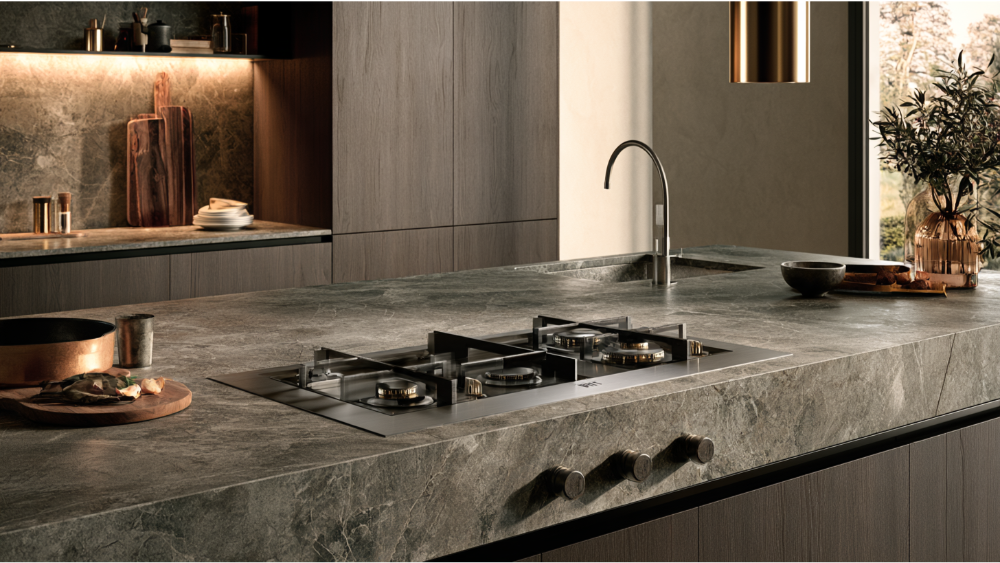
Pitt cooking integrated cooktop kitchen design places individual gas burners directly into countertop cutouts, with the working module hidden in the cabinet below, eliminating the appliance frame entirely. Configurations run from one to six burners or zones. Countertop material, cutout placement, cabinet depth, ventilation, and permits must all be finalized before fabrication begins, since stone cuts are permanent.
A cooking surface that disappears into the stone. The PITT Cooking system, which comes out of the Netherlands, sets individual gas burners, and in some markets induction zones, directly into a compatible countertop, with the working module hidden in the cabinet below. Unlike traditional cooktops, no framed appliance and no glass panel sits on your counter. Configurations currently run from one to six burners or zones, and the number you pick drives every decision downstream. It is a quiet way of redefining what a cooking surface can look like.
The look is easy to love. The planning is not. This guide covers configuration, suitable countertops, what happens below the counter, and what has to be locked in advance before cabinets and stone are fabricated for your kitchen. We are a design-build remodeler with cabinetry and stone fabrication in-house, so these details are our daily work.
What is a PITT gas cooktop, and how is it installed?
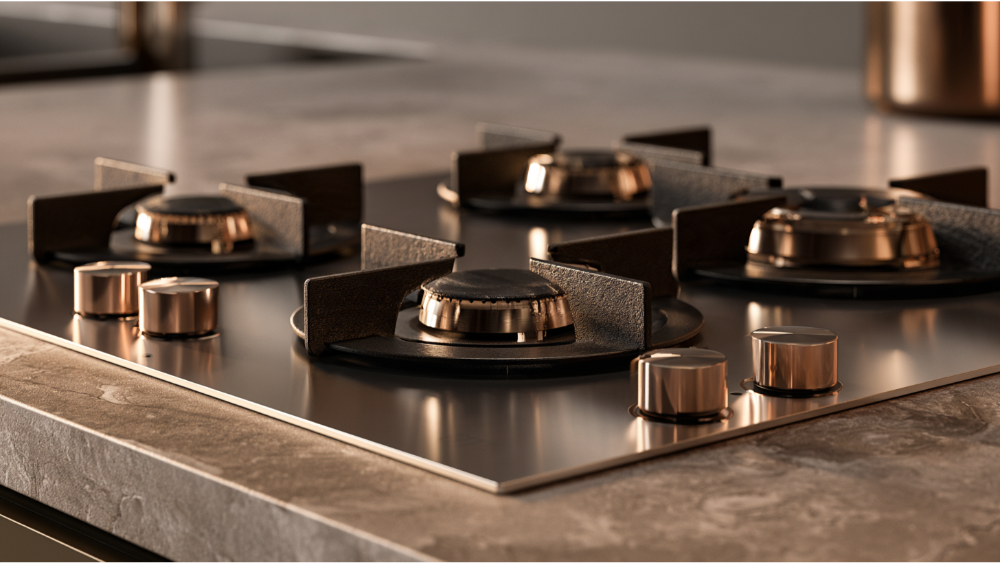
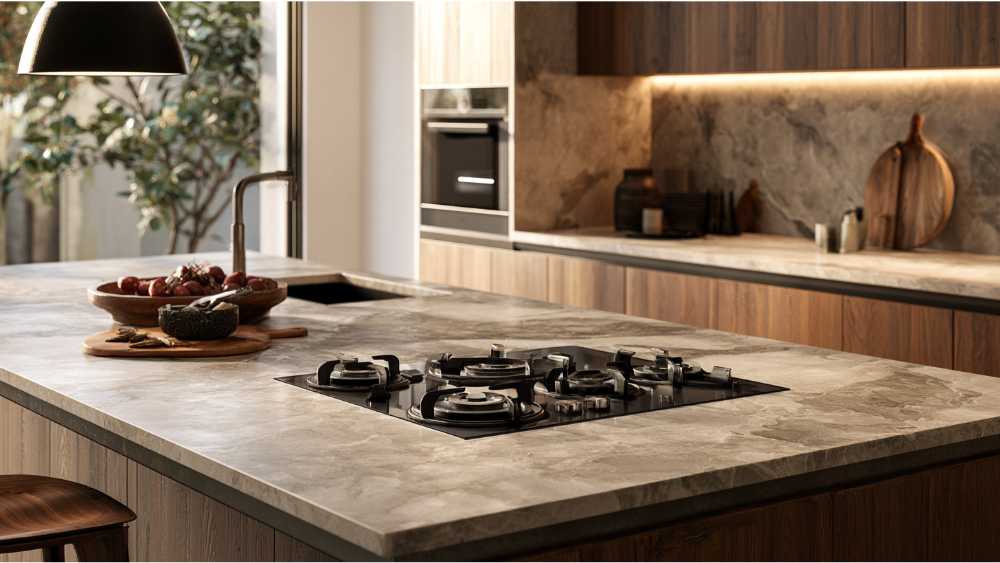
Where most cooktops drop into one rectangular hole, each PITT burner gets its own cutout. The module sits inside the cabinetry on PITT’s supplied support system and the burners are secured from above, which is what produces that unbroken, elegantly integrated surface. Cast iron grates sit on top in black or brass. The technology that makes it run is built into the module, completely out of sight.
One honesty note: the U.S. site now lists gas and induction assortments, but the induction overview still reads “Coming 2026” while the older FAQ describes PITT as gas-only. Confirm availability with our experts before specifying induction cooktops. This is not a DIY swap, and installation belongs with professionals who coordinate with the fabricator.
Why homeowners choose integrated gas burners
The counter reads as one surface. Your cooking zone stops looking like an appliance and becomes part of the room, and you gain real landing space beside the pans instead of a stainless border you cannot set anything on. Spacing between burners is generous, so a stockpot and a wok are not fighting for room. You hear the click, the flame answers instantly, and you feel that control the moment you stir fry. Cleaning is easy with no frame edges collecting grease.
Thanks to the modular design, we shape the cooking area around how your family actually cooks rather than around a rectangle a manufacturer picked. The whole idea is inspired by a simple belief: the counter should be the star, not the appliance. Looks get the attention, but the functionality is what wins people over. That is a different story than sliding a standard gas cooktop into a hole and calling it kitchen design.
How many burners do you need?
- What size cookware do you use daily?
- Do you wok-cook, or need a genuine low simmer?
- How many people cook at once?
- Island or perimeter run?
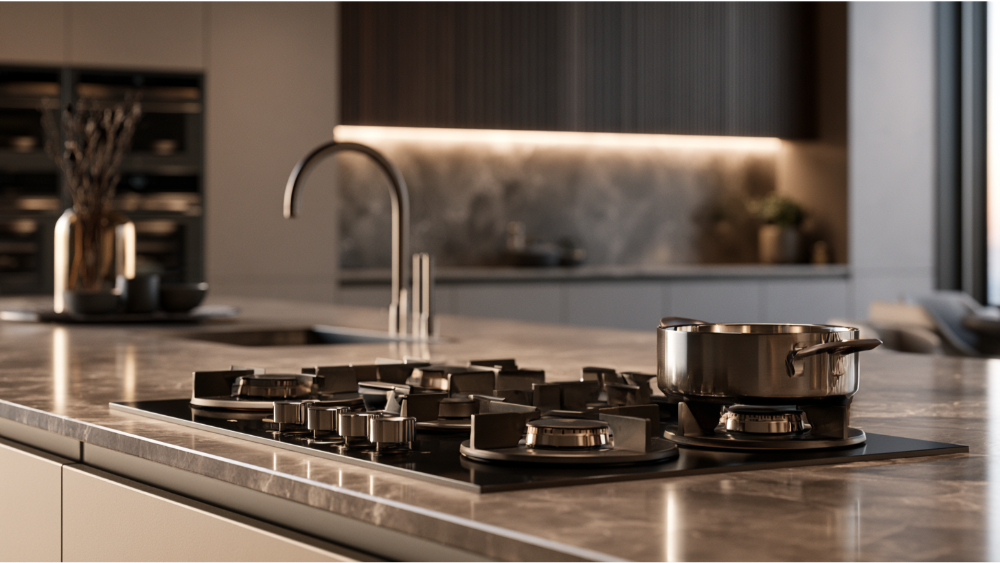
Your answers, not a catalog, should set the layout around your real cooking preferences. Gas burners range from roughly 1,024 to 6,142 BTU/h (small), 1,024 to 10,236 BTU/h (medium), and 682 to 17,061 BTU/h for the combined wok and simmer double-ring burner on a single control. Induction zones run 1,400 to 2,100 W and 2,300 to 3,000 W, all model-specific.
Burners cannot go just anywhere. Two small burners plus a wok burner is a common island setup, but manufacturer layouts, spacing minimums and cabinet widths govern the plan. Cabinet width runs from about 11 13/16 in. to 47 1/4 in. depending on model.
Which countertops work with PITT Cooking?
Here the countertop is part of the appliance installation, not just a style choice. If you are in doubt about a material, ask before the slab is ordered.
| Material | Status | Planning concern |
|---|---|---|
| Quartz composite | Permitted with conditions | Core thickness and heat exposure |
| Granite / quartzite | Permitted | Cutout quality, fissures, seam location |
| Marble | Permitted | Etching and staining beside a burner |
| Porcelain / Dekton-type | Permitted with conditions | Precision fabrication, edge durability |
| Concrete | Permitted | Sealing, thickness, reinforcement |
| Stainless steel | Permitted | Substrate and adhesive |
| Solid wood | Not permitted | Heat and movement |
| Solid surface / laminate | Excluded by current U.S. guidance | Older articles disagree. Do not rely on them. |
Permitted thickness generally runs 4 to 35 mm, with at least a 10 mm solid core for quartz composite, compact board and natural stone. Cutouts stay at least 150 mm from the counter edge, seams at least 250 mm from cutouts, with a 1 × 1 mm facet and a 3 mm expansion gap at walls and cabinets. That is precision craftsmanship, and a lot rides on getting the file right the first time. Thanks to our in-house stone shop, the cutout file and the slab layout get planned together.
Below the counter: cabinets, control knobs, and service access
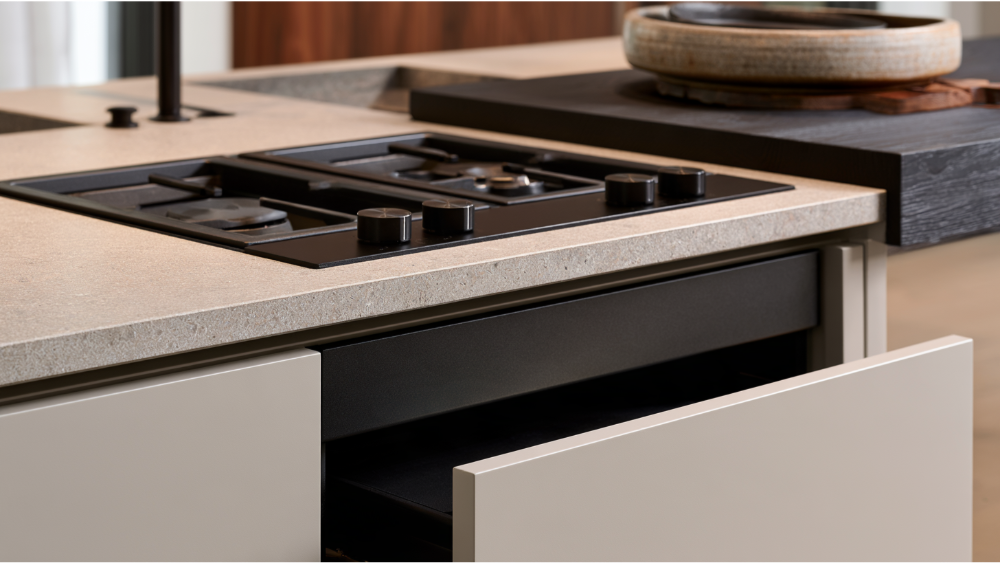
The PITT module and its supports prevent countertop deflection, and they eat depth. The induction manual lists about 118 mm (roughly 4 41/64 in.) below the counter surface, which changes drawer boxes, organizers and any oven planned underneath.
Top Side control knobs sit on the counter and read directly against each burner, with burner geometry designed for minimal heat transfer into the surrounding surface. Front Side control knobs keep the worktop clear but need more depth, about 25 9/16 in. minimum versus 23 5/8 in. typical, plus exact cabinetry coordination.
These units must stay removable for easy service without dismantling cabinets or countertop. Plan that path now, not in year six.
Ventilation, permits, and California code
An integrated cooktop does not reduce ventilation needs. Cooking produces grease, moisture and particles regardless of fuel, and a gas cooktop adds combustion byproducts. The EPA recommends an outdoor-vented hood whenever you cook and for 10 to 20 minutes after, and favoring rear burners because hoods capture them better. Induction guidance requires at least 30 in. clearance to an unprotected cabinet above.
California and Concord: The 2025 California Energy Code took effect January 1, 2026, with hood capture-efficiency or airflow minimums that vary by dwelling size and fuel, roughly 110 to 160 cfm over electric and 180 to 280 cfm over gas, and 300 cfm for downdraft systems. In Concord, kitchen remodels, new or extended gas piping, new cooktop wiring, a fuel change, and relocated exhaust fans require permits. That review takes time, and we handle permitting in-house.
Lock these decisions before fabrication
Once stone is cut, these things are permanent:
- Exact PITT model, fuel type and burner count
- Top Side or Front Side control knobs
- Cabinet width and internal construction
- Countertop material, structural thickness, final cutout file, seam placement
- Support system, gas line or electrical load
- Hood model, clearance, duct run, makeup air
- Drawer or oven placement below, plus the service-removal path
- Permit scope and warranty registration
Manufacturer terms list 24 months on indoor household gas products, extending to 60 months with registration, and 24 months on indoor induction products. That is separate from our 24-month labor warranty on remodel work.
Because design, DreamLine Custom Cabinetry, stone fabrication, permitting and installation happen under one roof, no one is blaming another trade for a cutout that landed a quarter inch off. The result is one contract and one accountable team. Family-owned since 2001, 19,000+ homeowners served, CSLB License #853669, A+ BBB accredited.
See configurations, slabs and cabinetry together in our 20,000-square-foot showroom in North Highlands, or schedule a free consultation. Call (916) 701-9660 or request a free estimate online.
PITT Cooking FAQ
What is a PITT cooktop?
A modular system with individual burners set into separate countertop cutouts and the working module hidden in the cabinet below. One to six zones, with cast iron grates in black or brass.
What are the benefits over traditional cooktops?
Continuous stone with no appliance frame, more usable space around the burners, clearance for large cookware, and a quiet minimalist style. On an island where the kitchen is on display, that makes it an ideal choice.
How do you clean a PITT cooktop?
The heat shield doubles as a catch tray for boil-overs. Burners lift off for washing but are not dishwasher-safe. Clean shortly after use and follow your countertop maker’s care instructions, since more stone sits exposed. Etching matters most on marble.
Where can I buy one, and what does it cost?
PITT Cooking is sold through authorized dealers and design-build remodelers. Cost depends on configuration, control knobs, countertop and installation scope, so we quote it inside a free in-home estimate. Style is only part of the story, so come see it in the showroom first.